


Week 43 · Sessions 4 and 5 of Fall 2026 · Thursday, October 22 and Friday, October 23, 2026
This post is a rough log for our asynchronous members to view at a glance, rather than an elaborate or high-fidelity capture of the discussion. It covers two sessions. Abridged recordings will be posted to the JOPRO YouTube channel.
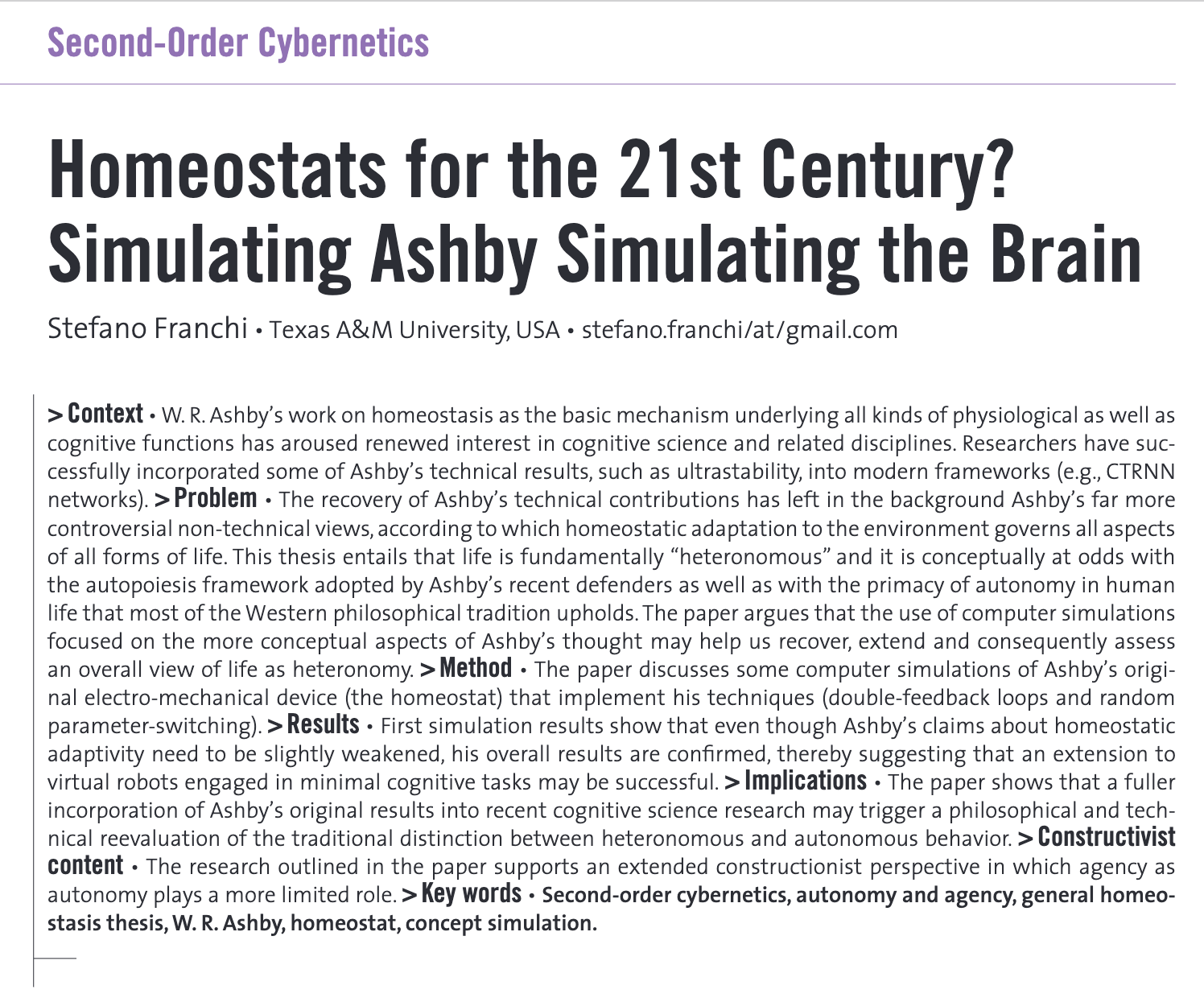
The Cognition Futures Reading Group continued Stefano Franchi’s “Homeostats for the 21st Century? Simulating Ashby Simulating the Brain”, published in Constructivist Foundations in 2013. Notes from sessions 2 and 3 cover Franchi’s seven theses, the sleeping machine, and Figures 4 and 5. On Thursday the group read on through Franchi’s case for the homeostat as a concept and his account of heteronomy. On Friday Avery Lim presented work that connects to the reading.
What was read
On Thursday, Jes Parent recapped sessions 2 and 3, and the group returned to the footnote on Franchi’s technical and non-technical theses. Thesis 1, general homeostasis, is philosophical; thesis 2 is biological; theses 3 and 4 explain how the first two would be realized. Franchi argues that reading the homeostat as a concept simulation lets attention fall back on theses 1 and 2.
Franchi then reads Ashby’s design work, from polystable and multistable systems to the principles of dispersion and localization, as a conceptual exploration of life as passive and contingent. On his account, Ashby is asking what the internal organization of a passive, contingent system would have to be like, and the homeostat serves as a complex thought experiment for answering it.
From that standpoint, Franchi says the most important of Ashby’s theses is the first: a complex system running to equilibrium generates complex behavior. Everything else is an explication or a consequence of it. Critical discussion has nonetheless focused on the derived claims, above all ultrastability. Franchi notes that Norbert Wiener, while praising Ashby, reduced homeostasis to a physiological instance of feedback, and that recent work, such as Ezequiel Di Paolo’s, grafts ultrastability onto neural network controllers. Both, he argues, privilege the object side of Ashby’s simulation over its conceptual side.
Franchi suggests the reason is the controversial status of the general homeostasis thesis itself. It insists that life is essentially heteronomous, governed from outside rather than self-governed. That puts it at odds with a long philosophical tradition that separates human from non-human life precisely on the line between autonomous and heteronomous behavior. Footnotes 13 and 14 tie this to a passage from Ashby that Franchi quotes: “There is yet to be written a book that shall show how all the organism’s exteriorly directed activities are similarly regulatory.”
On Friday the group did not read further. The group will move to the open peer commentaries next.
What was discussed
Lim’s essay and Ashby’s open book
Lim introduced “The Questions We Stopped Asking”, co-written with Parent, the first post in a series on what Lim calls mediated gestalt inference. Lim described it as a historical overview of a holistic, whole-system kind of inquiry that has been devalued, and said the next post will take up “domain primitives.” Lim connected the essay to Ashby’s claim that even high-order human drives, such as playing chess, can be described as homeostatic, and to the “yet to be written” book quoted above. Parent compared the essay’s project to the way the 1943 paper by Rosenblueth, Wiener and Bigelow reclaimed the term teleology, and stressed that it is not an argument against empiricism or the scientific method.
Simulating objects and simulating concepts
Lim asked whether Franchi’s distinction means that applying Ashby naively, at the level of cells, is wrong, while applying him at higher levels of organization is more accurate. Parent read Franchi differently: the distinction is about not reducing the homeostat to a brain simulation, because Ashby was also working through philosophical questions. Amanda Nelson pointed to Franchi’s remark that technical work in the cognitive sciences is sometimes philosophy in disguise. She described concept simulation as exploratory, playing with abstract concepts rather than aiming only at accurate reproduction, and noted Franchi’s point that a good model does both. Lim extended this: simulating a concept may improve understanding of the object itself. Nelson thought that was consistent with Franchi, and said she wished he had gone further on what the ideal combination looks like.
The sleeping machine and the dark room problem
Nelson asked how closely the sleeping machine relates to predictive processing’s dark room problem: if an organism’s aim were to minimize prediction error, it could simply shut itself in a dark, predictable room. That looks anti-life, and she noted it is presumably an old objection with many replies. Lim asked whether anyone has related it to sensory hypersensitivity, as in autism or migraine, where a predictable environment is sought. Nelson said organisms sometimes do face something like the dark room, but that it is generally taken as a sign something has gone wrong. Parent connected it to differing degrees of sensory permeability and to how many variables a person can hold at once.
Quiescence or set point?
Lim asked why Ashby and Franchi frame quiescence as the goal, rather than maintaining a set point with rest as the end of a cycle. Parent restated the question as whether a system reaches a stable local equilibrium in a larger landscape rather than the whole system going still, and noted that the word “quiescence” appears only once in Franchi’s article. Parent proposed collecting the group’s questions before reading the commentaries, so they can be compared with what the commentators and Franchi’s response say.
Heteronomy and what counts as life
Parent read the heteronomy passage and asked Nelson what it meant to her. Nelson connected it to her earlier point that a drive toward sleep looks anti-life. For Maturana and Varela, autonomy, a system’s self-production and self-regulation, is what defines life, and many philosophers have described something like a life force. If life is heteronomous in Ashby’s sense, she asked, how do we distinguish life from non-life? Parent said he wants to look into why the tradition settled on autonomy as the dividing line, as a review of the literature.
Preference as homeostasis
Lim suggested the group was circling preference and set points within subsystems, and proposed that preference and autonomy may themselves be the maintenance of a set point, dependent on homeostatic regulation. It is hard to explain why someone plays chess, Lim said, if the drive is only to do the minimum and return to rest. Lim pointed to individual differences in drives, such as the Big Five, need for cognition, and need for affect, and to a Frontiers paper on why people enjoy horror films, and suggested homeostasis may describe complex behavior better when it concerns information rather than survival. Parent placed this under what he calls the non-uniformity of phenomenological experience. Lim proposed grounding the next discussion in a triad of appetite for diversity, for intensity, and for quiescence, and planned to go back to what Ashby himself wrote about quiescence. This was raised as a direction to develop and was not settled.
The quiescence trap
On Friday, Parent shared a new interoception paper by Micah Allen and colleagues that names a “quiescence trap”: measuring interoception at rest, typically through a single channel such as heartbeat detection, when the field’s interest is in how bodily signals shape emotional life. Nelson read the term as an ecological validity problem, and Morgan Hough noted the paper’s use of video of people at great heights to induce arousal. The word is used differently than in Franchi, but the overlap was noted.
Lim’s presentation
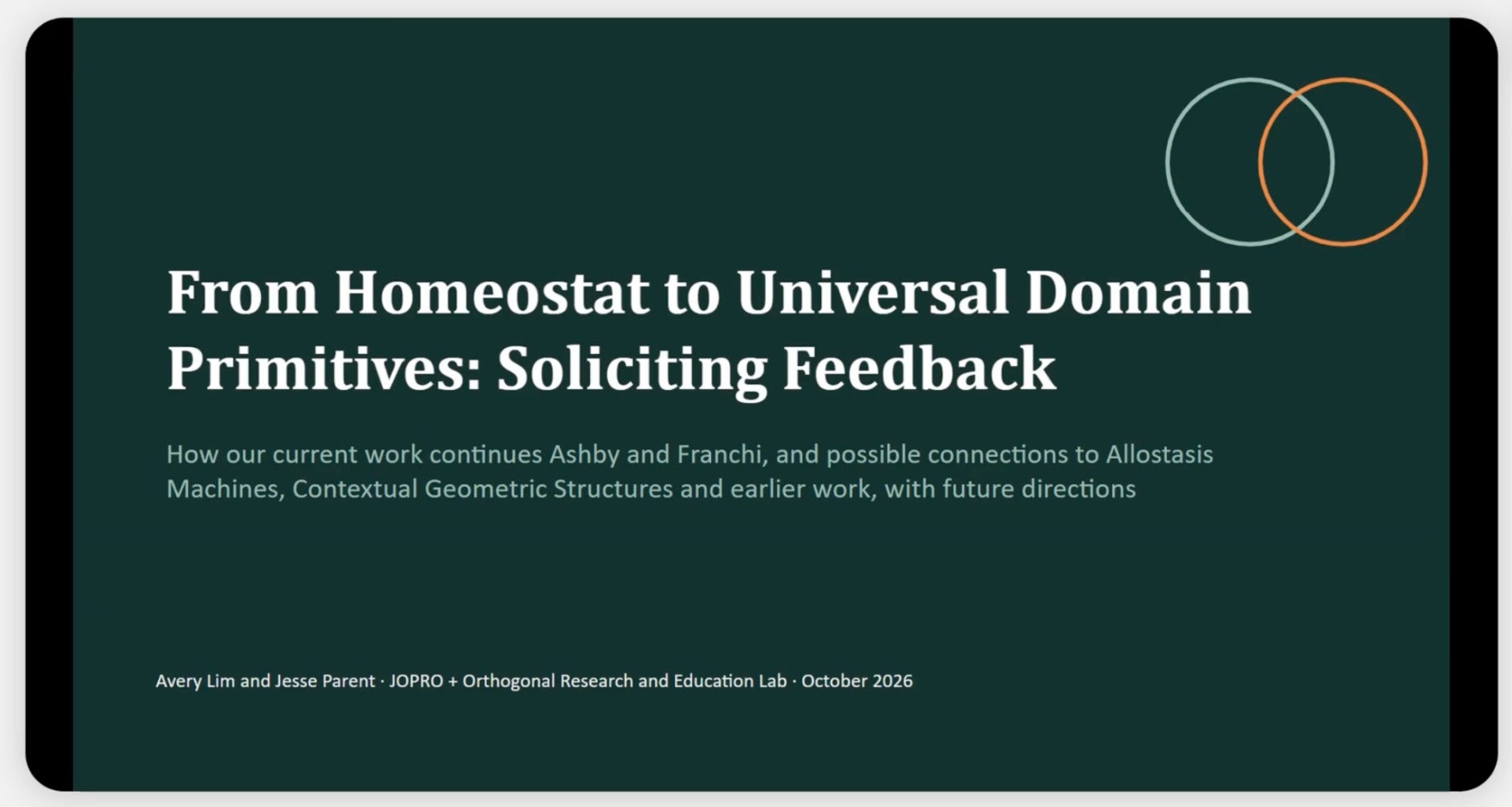
Lim presented on universal domain primitives and how they relate to Ashby, to Franchi’s reading, and to earlier work on allostatic kinds and allostasis machines.
Nelson asked whether the project is a kind of counter-Enlightenment argument, and whether a rationalist, modeling approach has limits for questions about life and consciousness. Lim answered that the argument is for integration rather than a rejection of Enlightenment methods, pointing to Hegel’s idea of sublation, and allowed that the essay’s title overstates the case. Bradly Alicea said the work partly matches the lab’s existing research, needs more connecting to it, and then needs testing.
Key terms
Heteronomy: behavior governed by something outside the system; the counterpart of autonomy.
General homeostasis thesis: Ashby’s first thesis, that a complex system running to equilibrium generates complex behavior.
Concept simulation: in Franchi, building a model to explore the consequences of an idea, as distinct from simulating an object such as the brain.
Dark room problem: the objection that an agent minimizing prediction error should seek a dark, unchanging room.
Quiescence trap: Allen and colleagues’ term for studying brain-body interaction only at rest.
Mediated gestalt inference: Lim and Parent’s name for holistic inquiry into connections that run through intermediaries.
Open questions carried forward
Why frame the homeostat’s goal as quiescence rather than maintaining a set point? (Lim)
If life is heteronomous in Ashby’s sense, what distinguishes living from non-living systems? (Nelson)
Can preference itself be modeled as set-point maintenance? (Lim)
What would the ideal combination of object and concept simulation look like? (Nelson)
What are the limits of a modeling approach to questions about life and consciousness? (Nelson)
Next time
The group moves to the open peer commentaries and Franchi’s response.
References
This session
Franchi, S. (2013). Homeostats for the 21st century? Simulating Ashby simulating the brain. Constructivist Foundations 9(1): 93–101. Open peer commentaries and the author’s response follow in the same issue. http://constructivist.info/9/1/093
Lim, A. & Parent, J. (2026). The Questions We Stopped Asking. JOPRO, October 19, 2026.
Rosenblueth, A., Wiener, N. & Bigelow, J. (1943). Behavior, purpose and teleology. Philosophy of Science 10(1): 18–24.
Maturana, H. R. & Varela, F. J. (1980). Autopoiesis and Cognition: The Realization of the Living. Reidel.
Allen, M., et al. The quiescence trap of measuring interoception at rest.
Earlier notes
The sleeping machine and the gradient: Franchi on Ashby’s homeostat, PT 2. Its further reading covers Andy Clark on the dark room problem and Peter Sterling on allostasis.
Further & Suggested Reading
These readings were not discussed on October 22 or 23. They were gathered after the sessions as starting points for the questions Lim and Nelson raised. The annotations are editorial.
What does a method set aside in order to work?
Jes Parent (2026), “Declared Abstraction: On Bracketing and Saying What You Leave Out”. A second look at the 1943 Rosenblueth, Wiener and Bigelow paper, arguing that its authors explicitly set aside the internal organization of the systems they studied and said what that cost. Relevant to Franchi’s claim that Ashby’s readers kept his technical theses and quietly set aside the philosophical ones, and to Nelson’s question about where modeling stops.
Where do the right primitives come from?
Battleday and Gershman’s paper on the easy and hard problems of AI for science, discussed and linked in “The Questions We Stopped Asking”. They argue that formulating a problem, including choosing its primitives, is the hard part of science. Lim cited it as a starting point for the domain-primitives work.