

This post is a rough log for our asynchronous members to view at a glance, rather than an elaborate or high-fidelity capture of the discussion. It covers two sessions. Abridged recordings will be posted to the JOPRO YouTube channel.
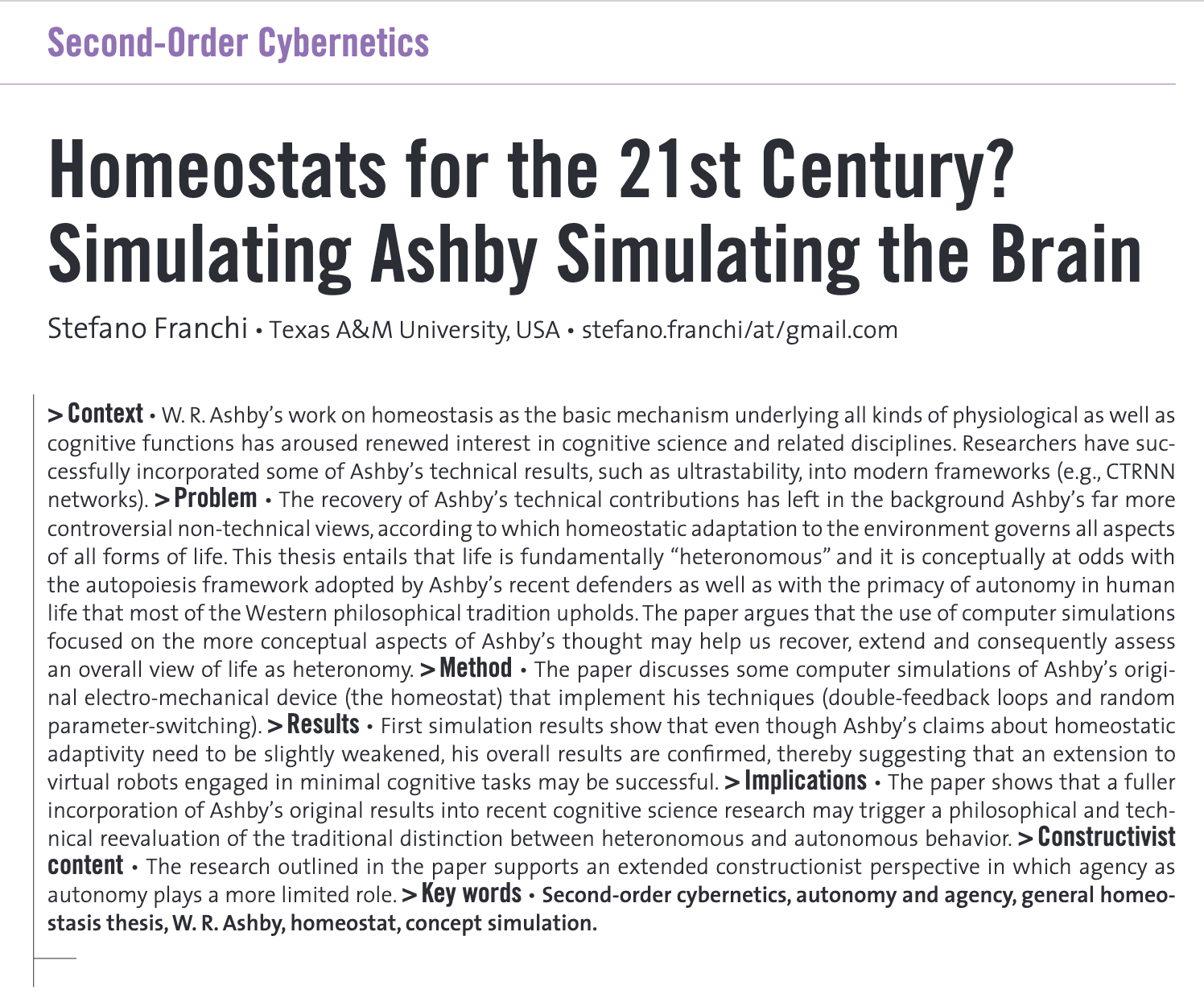
The Cognition Futures Reading Group continued Stefano Franchi’s “Homeostats for the 21st Century? Simulating Ashby Simulating the Brain,” published in Constructivist Foundations in 2013. Notes from session 1 cover the paper’s opening sections and its distinction between simulating objects and simulating concepts. On Thursday the group considered a first build for the Friday sessions and two recent talks on AI and human relationships. On Friday it returned to the paper.
What was read
On Friday, Parent recapped the first session for anyone new, and the group read on from the end of “Simulating objects vs. simulating concepts” to paragraph 10 of “The homeostat as a concept,” then turned to Figures 4 and 5 from the paper’s later sections.
Franchi notes that most readers treat Ashby’s homeostat as a proxy object, a drastically simplified brain, and argues it should also be read as a proxy concept. He reduces Ashby’s theory to seven theses. The first four: a complex system running to equilibrium generates complex behavior; a system is in equilibrium when it keeps its essential variables at stable levels; it reaches equilibrium through ultrastability, rearranging the connections between its parts when those variables become unstable; and it achieves ultrastability through a stochastic step function that randomly steps through the parameters connecting its parts. From his experiments Ashby derived three more: a fully connected system takes an exceedingly long time to reach equilibrium, so a real system needs weak connections among its parts, and its subsystems will typically communicate through the environment rather than directly.
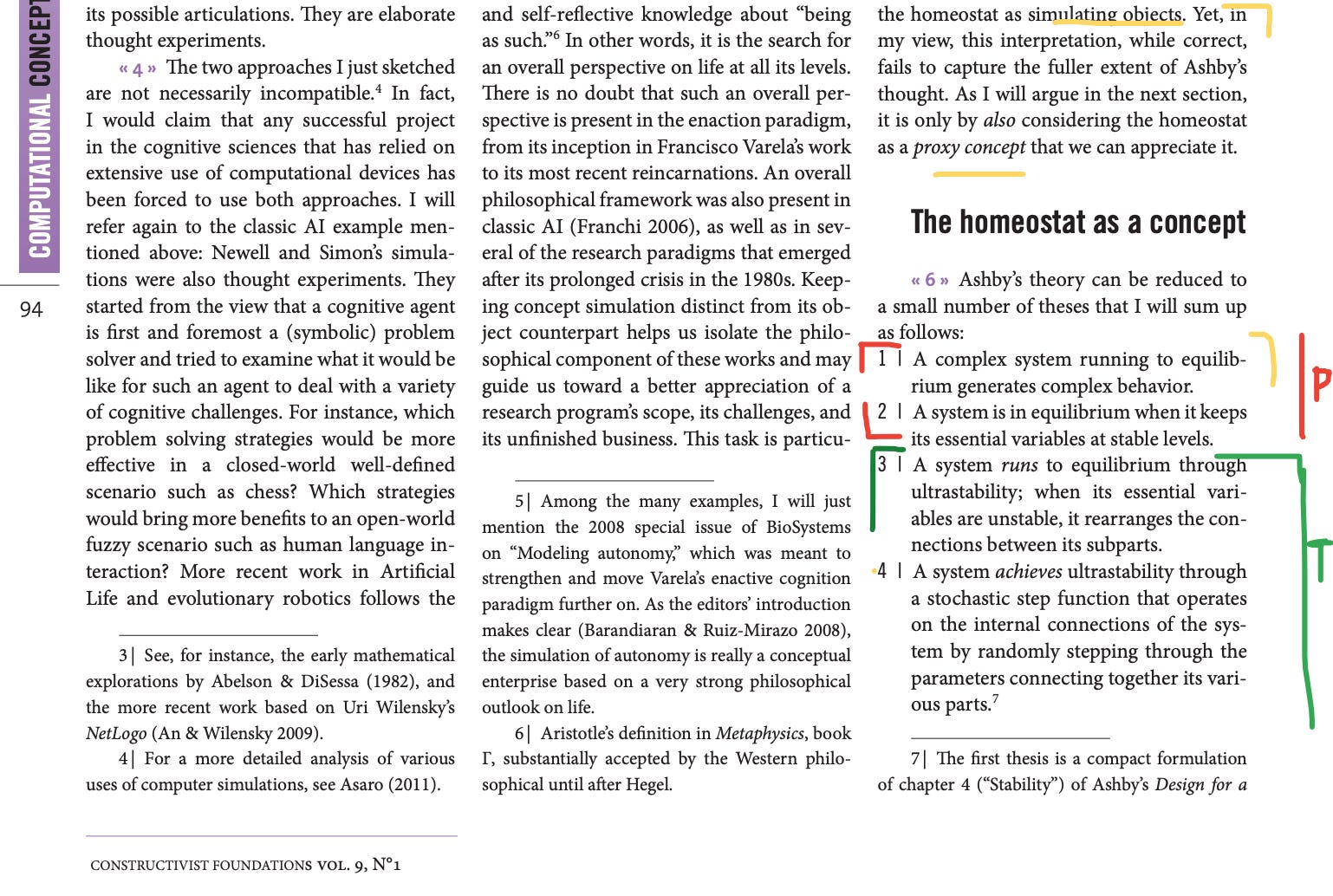
Franchi calls the first thesis, generalized homeostasis, Ashby’s most original and least warranted idea, and the second his least original but most solid. The third and fourth are Ashby’s core technical contribution. In a footnote he explains that readers interested in building artifacts or explaining biology have focused on theses 3 and 4 and let 1 and 2 slide, and that reading the homeostat as a concept simulation brings the philosophical and biological theses back into view.
The passage closes with William Grey Walter’s nickname for the homeostat, machina sopora, the sleeping machine. Franchi finds the jibe superficial but telling: on Ashby’s view, the homeostat “will act as much as is needed in order to go back to sleep.” It is passive, because its activity is a by-product of seeking rest, and contingent, because its search for equilibrium runs through random processes.
Figure 4 shows the minimal two-unit homeostat as an agent and an environment, the agent negatively self-connected and the environment not, joined by sensory and motor transducers. Figure 5 places that setup inside a Braitenberg-style vehicle with one sensor and one wheel, moving in an environmental gradient between upper and lower bounds. Franchi maps his three experimental outcomes onto it: the vehicle rests at the optimum, oscillates back and forth between the bounds, or settles into constant motion that keeps its essential variable within tolerance without reaching the top.
What was discussed
A first build for the Friday sessions
On Thursday, Amanda Nelson proposed using Franchi’s paper as a guide for a first build: replicating the homeostat and its small experiments, and possibly the vehicle in Figure 5. Her reasoning was that a setup someone else has already specified would show the group what it does not yet know about building one. There was further discussion of Franchi’s footnote on Braitenberg’s vehicles, whose simplest types are routinely used to introduce reactive architectures that wire a sensor directly to a motor, and noted that Franchi’s robot replaces that direct link with a homeostatic unit. The proposal was welcomed as a candidate; nothing has been scheduled. Nelson also said she is keen to read the peer commentaries.
What quiescence can explain
On Friday, Lim asked how far Ashby’s model reaches. Some human drivers relate to allostatic adaptation, and others are aesthetic play and social games, such as watching horror films. These might be modeled as reaching a set point and then returning to rest, but it is not clear how quiescence as the goal accounts for them. Lim also suggested that ultrastability might be reached through several entry and exit points, different perspectives on the same system, and that this could supply the alternatives a system needs before it can evaluate goals at all. Parent connected this to Lim’s earlier question, “where do goals come from?”, raised when the group read the telic states paper, and to the idea that information can only be transmitted as a choice among alternatives. These were raised as ideas to pick up and were not developed further.
Franchi’s Figures 4 and 5


Bradly Alicea walked the group through the figures. In Figure 4 he traced the double feedback: one loop between agent and environment through the sensory and motor transducers, and a second through the agent’s feedback onto itself. He read Figure 5 as gradient following: as the vehicle climbs the gradient the signal strengthens and reinforces its path, so a simple vehicle can lock onto a local maximum, such as light reflecting off a bright surface, instead of the actual source. Lim summarized this as local reward versus global modeling. Alicea suggested richer feedback could let a vehicle distinguish sources, compared the simple case to being in an information bubble, and said the figure raises more questions than answers.
Related Discussion
Moral reasoning and self-report
Parent recapped a talk by Cody Turner at a Boston University event, based on Turner and Nir Eisikovits’s paper “Programmed to Please,” which treats AI sycophancy as an Aristotelian vice with moral and epistemic harms. He shared notes from a Data x Direction members also attended, on how AI sycophancy differs from the human kind and how training on human preferences rewards affirming answers.
Nelson asked whether the question of a model’s moral reasoning is already answered by the reasoning some models display, or by the instructions they are given. Parent answered with Julia Haas and colleagues’ roadmap for evaluating moral competence in large language models and its facsimile problem: a model may produce appropriate moral outputs without reasoning from morally relevant considerations. He also considered the matter as a self-report problem, familiar from clinical psychology, where what someone says about their own state may be unreliable or misleading on its own.
Parent added that discussions of AI ethics outside technical fields often treat a model as a fixed entity, and that this misses how models work: there is no fixed persona, context is limited and gets compacted, and memory is far from perfect. He tied this to Sacco, Sakthivadivel, and Levin on topological limits to self-organization, which the group read earlier this year, and floated the idea of a teaching resource on how LLMs are structured, written for non-specialists.
Language as a social relation
Hough argued that chatbots, which have no goals or desires of their own, nonetheless pull on evolved needs for social relation. He pointed to Emily Bender’s work on pragmatics and to the psychiatrist Matthew Nour, who he noted is now at Microsoft Research. He also asked what linguists are saying about the effect of LLMs on human language, suggesting lingbuzz as a place to look.
Turkle’s Artificial Intimacy
Parent attended an event for Sherry Turkle’s new book, Artificial Intimacy: Who We Become When We Talk to Machines, and shared three points: her account of a companion-chatbot founder crediting Turkle’s earlier work as the basis of their business; her repeated question of what the end game is, which Parent connected to his own framing of destinations; and her stated decision in this book to center humans deliberately.
Technology is seductive when its affordances meet our human vulnerabilities - Sherry Turkle, Alone Together
LLMs as a cognitive virus
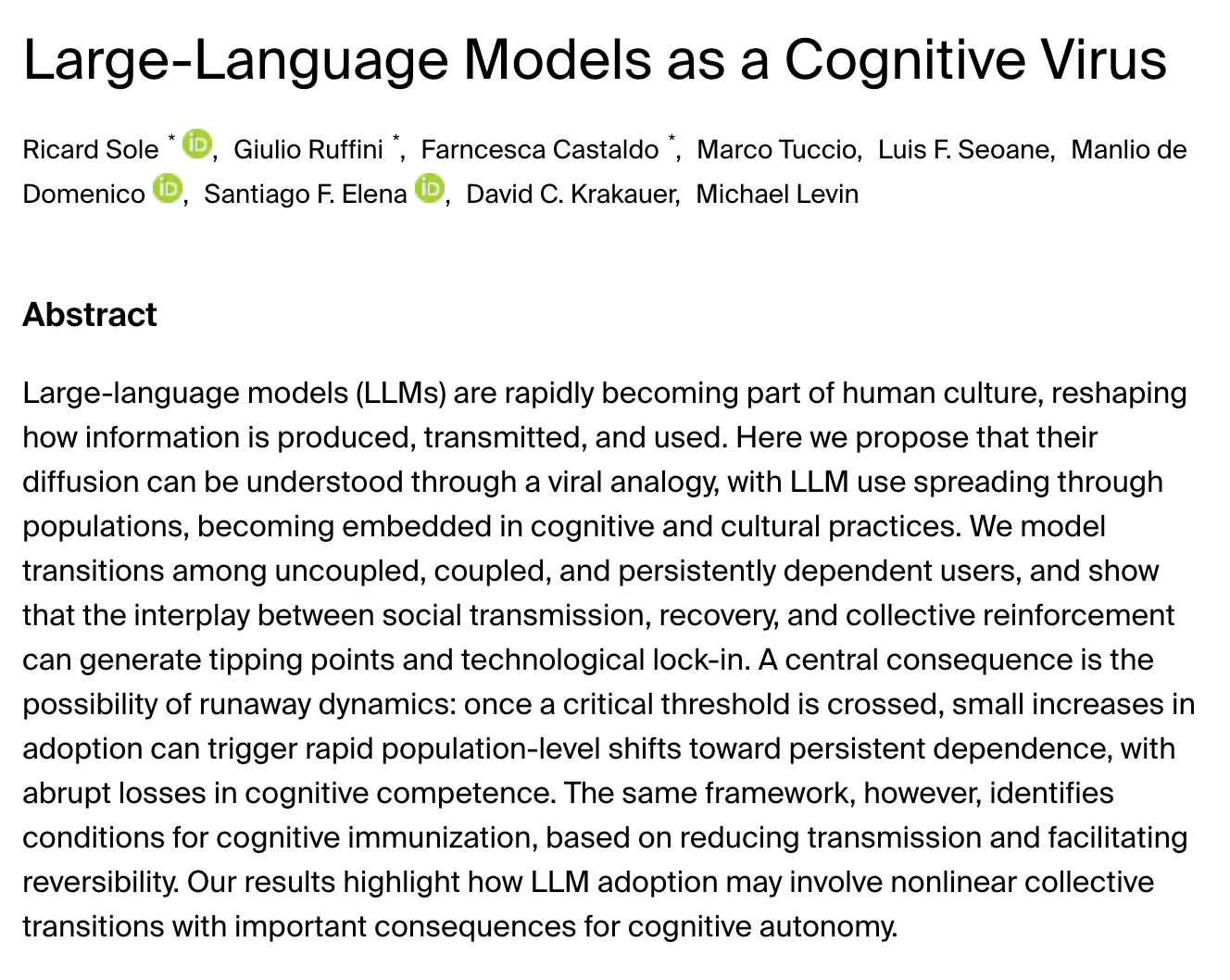
Parent flagged a recent preprint that models the spread of LLM use through a population with an epidemiological analogy, including tipping points and “cognitive immunization.” Hough connected it to multi-compartment diffusion models and asked to discuss it when there is time.
Key terms
Homeostat: Ashby’s electro-mechanical device of four fully connected units, each able to randomly reset its connection weights.
Essential variables: variables a system must keep within bounds to remain viable.
Ultrastability: reaching equilibrium by rearranging internal connections whenever essential variables go out of bounds.
Uniselector: Ashby’s name for the random step mechanism that does the rearranging.
Machina sopora: Grey Walter’s “sleeping machine” nickname for the homeostat.
Heteronomy: behavior governed by something outside the system; the counterpart of autonomy.
Braitenberg Type 1 vehicle: a simple robot with one sensor wired to one motor.
Facsimile problem: Haas and colleagues’ term for a model imitating reasoning without genuine understanding.
Open questions carried forward
Could Franchi’s homeostat and vehicle serve as a Friday build, and what would the group need to learn first? (Nelson)
How far can a quiescence-seeking model account for play, aesthetics, and social drives? (Lim)
Where do goals come from in an Ashbian system? (Lim)
What kind of feedback would let a simple vehicle tell a reflection from a source? (Alicea)
What are linguists saying about how LLMs are changing human language? (Hough)
Can a model’s moral reasoning be assessed beyond what it reports about itself? (Nelson, Parent)
Next time
The group continues Franchi’s paper. Whether it finishes the target article or moves to the open peer commentaries first is still open.
References
This session
Franchi, S. (2013). Homeostats for the 21st century? Simulating Ashby simulating the brain. Constructivist Foundations 9(1): 93–101. Open peer commentaries and the author’s response follow in the same issue. http://constructivist.info/9/1/093
Braitenberg, V. (1984). Vehicles: Experiments in Synthetic Psychology. MIT Press. https://mitpressbookstore.mit.edu/book/9780262521123
Turner, C. & Eisikovits, N. (2026). Programmed to please: The moral and epistemic harms of AI sycophancy. AI and Ethics 6. https://link.springer.com/article/10.1007/s43681-026-01007-4
Haas, J., Bridgers, S., Manzini, A., et al. (2026). A roadmap for evaluating moral competence in large language models. Nature 650: 565–573. https://doi.org/10.1038/s41586-025-10021-1
Sacco, F., Sakthivadivel, D. & Levin, M. (2026). Topological constraints on self-organization in locally interacting systems. Philosophical Transactions of the Royal Society A 384(2320): 20250011. https://doi.org/10.1098/rsta.2025.0011
Amir, N., Tiomkin, S. & Langdon, A. (2026). Goals and the structure of experience. Philosophical Transactions of the Royal Society A 384(2320): 20250004.
Turkle, S. (2026). Artificial Intimacy: Who We Become When We Talk to Machines. Little, Brown. https://www.hachettebookgroup.com/titles/sherry-turkle/artificial-intimacy/9780316573962/
Solé, R., et al. (2026). Large-language models as a cognitive virus. arXiv:2609.03344. https://arxiv.org/abs/2609.03344
Further & Suggested Reading
These readings were not discussed on October 15 or 16. They were gathered after the sessions as starting points for the questions Nelson, Lim, and Alicea raised. The annotations are editorial.
Can a model’s account of its own reasoning be trusted?
Miles Turpin, Julian Michael, Ethan Perez, and Samuel Bowman (2023), “Language Models Don’t Always Say What They Think: Unfaithful Explanations in Chain-of-Thought Prompting”. The authors bias models toward particular answers through features of the prompt, such as reordering multiple-choice options, and find that the step-by-step explanations rationalize those answers without mentioning the bias. A direct test of Nelson’s question about whether displayed reasoning shows what drives an output.
Anthropic (2025), “Reasoning models don’t always say what they think”. A follow-up that tests the faithfulness of reasoning models, which show their working by design, and reports largely negative results: models often used hints in reaching an answer without mentioning them. The Haas et al. roadmap makes a related point, noting it is unclear whether reasoning traces reflect the processes that actually produce a response.
Can a system that seeks rest account for activity?
Andy Clark (2013), “Whatever next? Predictive brains, situated agents, and the future of cognitive science”. Behavioral and Brain Sciences 36(3): 181–204. Clark’s target article on the brain as a prediction machine. In his commentary on Franchi, Tom Froese cites it for the “dark room” problem, the question of why an agent minimizing surprise would do anything at all, as a modern version of the sleeping-machine worry. Relevant to Lim’s question about horror films and play.
Peter Sterling (2004), “Principles of allostasis: Optimal design, predictive regulation, pathophysiology and rational therapeutics,” in J. Schulkin (ed.), Allostasis, Homeostasis, and the Costs of Adaptation, Cambridge University Press. Allostasis treats regulation as predictive rather than fixed around a set point. Robert Lowe’s commentary on Franchi draws on it to argue that organisms must sometimes operate outside their comfort zone, which bears on Lim’s mention of allostatic adaptation.
On the vehicle
Ezequiel Di Paolo (2000), “Homeostatic adaptation to inversion of the visual field and other sensorimotor disruptions,” in From Animals to Animats 6, MIT Press: 440–449. Franchi cites this as the leading example of grafting Ashby’s ultrastability onto a neural network controller. A worked example of the kind of build Nelson proposed.
From the article’s own commentaries
Several of the open peer commentaries, which the group has not yet reached, take up these questions directly. Matthew Egbert and Inman Harvey both argue that keeping essential variables within bounds is not passive, using a pole balanced on a fingertip and a homeostatically controlled bicycle. Takashi Ikegami asks where the “dice” behind Ashby’s random rewiring come from and whether they are biased, which sits close to Lim’s entry-points idea. Franchi’s response sets out seven senses of “passivity” and answers the bicycle and pole examples.