


This essay opens an emerging line of work on mediated gestalt inference. It traces why one kind of inquiry, the kind that senses how whole systems hang together, lost its standing, and why we think it can be brought back on better terms. We’re publishing it as groundwork for a research program and forthcoming publications, and as an invitation to anyone working on related problems.
- Avery Lim & Jes Parent
Avery Lim is co-founder and co-lead of JOPRO’s DigiNEST, senior contributor to the Cognition Futures and Society Ethics Technology working groups, and a co-founder of Plot Twisters. Since 2021, Avery’s research has asked how living and artificial systems relate what happens inside them to what happens around them, with origins within the Allostatic Kinds research theme.
Since the Scientific Revolution, one kind of inquiry has been ranked below another, and the ranking has limited scientific and technological progress. The lower-ranked kind is holistic and broad. It asks how whole systems hang together and treats felt experience as evidence, the way a mystic senses a life as one meaningful whole or a poet feels that a craggy landscape and a particular grief belong together. The higher-ranked kind is precise and immediate. It isolates variables and checks them quickly, the way an experimenter changes one factor while holding the rest fixed. We think the strengths of the first should be recovered, and we also think some of its demotion was earned, given how untempered and unrefined many of its historical uses were.
But the fields where progress has stalled most, from multisystem illness to consciousness research and AI, need the two working together. The geneticist Barbara McClintock showed what that looks like. Her “feeling for the organism” told her where to look, and years of careful genetics confirmed what she found: genetic elements can move within a genome.
That kind of integration still lacks the definitions and infrastructure that precise inquiry takes for granted, and the stakes go beyond method. In each of these fields, whole-system patterns and precise details shape each other, so understanding the problem means modeling how the two relate. The tools for building such models, for describing what a felt sense of a whole is tracking and how it connects to measurable detail, are scattered across fields and rarely designed for problems this open-ended.
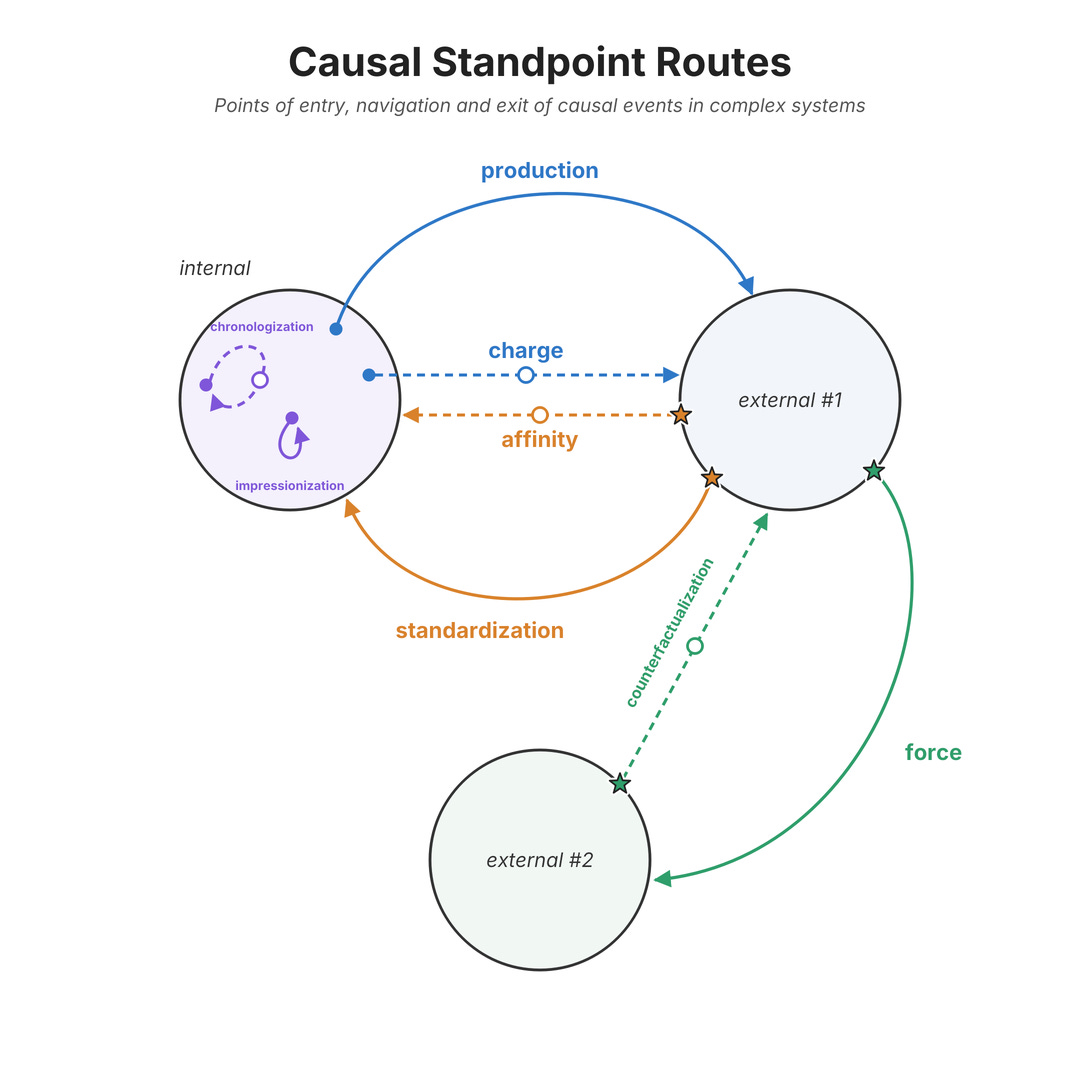
Our name for the kind of inquiry we’re after is mediated gestalt inference. A gestalt is a whole that organizes its parts, the way a melody is more than a list of notes. “Mediated” marks what this kind of knowing usually tracks: connections that run through intermediaries and spread across many interdependent parts, rather than anything that can be observed directly. “Inference” is a deliberate choice that connects this work to neuroscience and computer science, where the term names how systems estimate from evidence the structure that produces it, as in predictive accounts of the brain and in probabilistic and causal inference in machine learning.
In Karl Friston’s active inference, a living system never touches the causes of its experience directly; it infers them from the signals it receives, and machine learning likewise estimates hidden structure from the data it can see. Although the name leans toward these bridges to formal modeling and technology, we use it for holistic, broad reasoning itself, and we want to treat that reasoning as something that can be defined from first principles, modeled computationally and evaluated and trained by unambiguous criteria, rather than only as an amorphous skill to cultivate, or a gift some people have and others lack. The claim the series builds toward is that once holistic inquiry has definitions like these, it can be paired with precise inquiry by design instead of by luck.
This is not a new preoccupation for us. In 2021, together with other colleagues, we presented Allostatic Kinds at Neuromatch 4. Allostasis is the way living systems stay stable by anticipating and adjusting rather than holding still, and our proposal was a taxonomy of how that balancing between internal needs and outside context shapes which way causation runs between an agent and its environment. Whether a relation is held as subjective, objective or intersubjective, we argued, changes the direction of cause and effect, and the same regulation sets the boundaries of the basic units that make up felt meaning. A companion preprint, Allostasis Machines, carried the idea into technological environments. Looking back, it was an early attempt at what this series argues for: a precise account of how a whole-system state and specific mechanics shape each other.
We are now applying elements of that work towards AI. A manuscript on Lim’s concept of Causal Standpoint Taxonomies is under development, with other materials in preparation. This series lays the groundwork for two papers. The first, working title Mediated Gestalt Inference and Epistemic Primitives1 is a position paper and an open call. It makes the case that holistic inquiry needs computational definitions and research infrastructure of its own, and it is written to find allies who want to build them. The second is our own attempt at one such framework, applied to how language models represent agents, standpoints and causation.
Much of this thinking took shape in conversation: throughout various JOPRO working groups2, in weekly DigiNEST discussions on how digital tools reshape narrative, authorship and agency, and within Plot Twisters, where narrative is a tool for self-reflection and imagining futures. If any of it overlaps with your own work, we’d like to hear from you.
This first essay does the historical work. Before proposing anything, we want to show how one way of knowing came to rank below another, because we think that history explains why some of our hardest problems have stalled.
The easy problem and the hard problem
David Chalmers famously divided the study of consciousness into “easy problems,” which concern explaining what the brain does, and the “hard problem” of explaining why any of it is felt. Ruairidh Battleday and Samuel Gershman have recently applied the same distinction to science itself. In their account, the easy problem is solving a well-specified optimization problem that domain experts have already defined and for which data is plentiful, and it is here that recent AI has made its most impressive discoveries. The hard problem is the formulation of the problem in the first place, a task that requires continual conceptual revision under poorly defined constraints. Current algorithms, they argue, have limited capacity to meaningfully address this, and understanding how human scientists manage it should become a research priority in its own right.
The fundamental barrier to automating science is conceptual. Great scientists are not simply extraordinary optimizers of ordinary optimization problems—problems in which the data, space of solutions and an objective function for assessing the fit between them are already well defined. It is not like Einstein had a better function approximator in his brain than his peers did. More commonly, great scientists are ordinary optimizers of extraordinary optimization problems, and it is the formulation of the problem itself—not its solution—that is the truly hard problem. The hard problem is the ‘problem problem’. - Battleday and Gershman
Their distinction names something larger than a gap in AI. Knowledge work as a whole has its own Chalmers-style hard problem: a set of questions whose nature and contents sit uneasily with the way academia and industry are organized. These questions are difficult in themselves, but they are also hard because the kind of thinking they require is often devalued, underfunded and kept at the edges of science and engineering.
Battleday and Gershman also take up an earlier critique by Chalmers, French and Hofstadter: AI discovery systems are usually handed representations that already contain the primitives the final theory needs, which sidesteps where those primitives come from and how we know they are the right ones. That question is a major inspiration for the work on mediated gestalt inference this series develops.
A hierarchy of inquiry
Research funding and publication data make part of this hierarchy visible. In a study of all 18,476 proposals submitted to the Australian Research Council’s Discovery Programme over five years, Lindell Bromham and colleagues found that the more interdisciplinary a proposal was, the less likely it was to be funded. Erin Leahey and colleagues found that scientists who do more interdisciplinary work publish fewer papers even though those papers are cited more, a high-risk, high-reward profile that carries a career penalty in the meantime. A later study of 44,419 UK research grants by Ye Sun and colleagues suggests that the rewards can arrive eventually, since interdisciplinary researchers who begin with lower publication impact go on to outperform specialists in funding. Taken together, these findings describe a system that penalizes both work whose value takes time to become apparent and work that actively challenges the norms of research within a field.
Funding and publication counts, however, are only the visible surface of a deeper ranking of kinds of inquiry. Some ways of asking questions carry authority by default, while others are treated as soft, decorative or suspect regardless of their subject.
Inquiry that receives low status
The lines of inquiry we want to examine share a family resemblance. They study whole systems and how a situation fits together instead of isolating a single variable, and so they tend to track gradients and overall patterns rather than sharp categories. What they follow is usually mediated by intermediaries and spread across many interdependent parts, which is one reason their claims remain hard to falsify, at least until someone develops clean tests for them. They also treat subjective, first-person experience as a legitimate source of evidence.
Such approaches rank below information that can be counted and checked quickly and mechanically, and their subordination usually takes one of three forms. Sometimes they are tolerated as inspiration. Philosophy is a partial example: it remains a valued, if undervalued, consultant to the sciences. The broader way of knowing it sometimes draws on fares worse, since attention to wholes, to how parts connect, and to feeling and affect, both for what they reveal and as model cases of holistic inquiry, is rarely treated as a source of research direction in its own right. Sometimes they are put to work in a service role, as in much of psychology, social work and care, where they help people cope with systems designed according to other kinds of knowledge. Their least constrained versions end up confined to the arts or dismissed as folksy, feminized or childish, and are treated as interests rather than as authoritative ways of knowing.
This hierarchy has been examined and challenged many times, from C. P. Snow‘s account of the divide between scientific and literary culture to Evelyn Fox Keller‘s work on how objectivity came to be coded as masculine, and from Donna Haraway and other feminist thinkers to phenomenologists who treat feeling as a way of knowing. These critiques are well developed. Keller’s biography of Barbara McClintock gave them a concrete face, tracing how one scientist’s intimate, whole-organism way of knowing shaped both her discoveries and the long delay in their recognition. Much less attention has gone to turning them into working methods within science and engineering.
When these questions had authority
For most of history, the questions we’re describing held a central place in serious inquiry. Aristotle’s natural philosophy asked what things are for as well as how they move, so that purpose and the whole formed part of any explanation. From Hippocrates and Galen through the eighteenth century, medicine understood illness as an imbalance involving the whole body and its surroundings rather than a defect in a single part. Renaissance thinkers read the world through correspondences between the body, society and the cosmos, and as late as the seventeenth century Spinoza still placed the passions at the center of his account of nature and mind.
The same reasoning shaped knowledge well outside scholarship. Village healers, midwives and herbalists considered a sick person in relation to their household and the season, while farmers understood weather, soil and animals as parts of one connected system. Religious traditions built whole disciplines around attending to the mind and interpreting inner experience. The Ignatian practice of reading inner consolation and desolation as guidance, for instance, treated felt experience as a source of knowledge, and Blaise Pascal, a gifted mathematician and a contemporary of Descartes, held that the heart has reasons that reason does not know.
In the Western world, religion also carried this way of knowing into the centers of power. For much of the medieval and early modern period, the Church shaped universities, law, medicine, the calendar and the legitimacy of rulers, and theology was known as the queen of the sciences.3 A great deal of religious knowing consists of a felt understanding of how a life, a community and the cosmos fit together, including what matters and what things are for.4 While religion held power, then, this mode of reasoning was more widely used and more closely tied to authority than it is today.
Even so, religious institutions seldom let this way of knowing operate on its own terms. At times, it was turned toward narrower ends such as wealth, political control and salvation sold piece by piece, of which the trade in indulgences that helped set off the Reformation is a primary example. Claims about the meaning of the whole world were made to serve specific individual and material goals, and they were rarely paired with careful methods for checking them. In this sense the knowledge was already subordinated and unintegrated, borrowed for its authority rather than practiced as a way of knowing. As the Reformation, the Scientific Revolution and the gradual separation of church and state pushed religion toward private life, the way of knowing associated with it went along.
Some traditions took a different path. In Braiding Sweetgrass, the botanist Robin Wall Kimmerer, a member of the Citizen Potawatomi Nation, describes Indigenous knowledge in which reciprocity with the living world is itself the goal rather than a means to some narrower end. Relationships with plants, land and other beings inform what counts as a good harvest, a good life and good knowledge, and her own work brings this understanding together with the precise methods of botany. The Mi’kmaw Elder Albert Marshall’s idea of “Two-Eyed Seeing,” which means learning to see with the strengths of Indigenous and Western ways of knowing at once, expresses a similar aim. Traditions like these keep holistic, broad knowing at the center of a community’s values and show that it can work alongside careful observation.
In Europe, the Scientific Revolution brought a decisive change. In 1623 Galileo argued that colors, tastes and warmth exist only in the perceiver and not in nature itself, which left measurable quantity as the proper subject of science. Descartes went further, dividing the world into a thinking mind and a body that operated like a machine.5 Even the heart, long regarded as the seat of feeling, became in his account a mechanical furnace that heated and drove the blood, and the passions became bodily disturbances felt by the soul, sometimes useful but always to be governed by reason and will. Some three centuries later the neuroscientist Antonio Damasio would call this “Descartes’ error,” the belief that reason can stand apart from feeling and the body.
The same shift reached governance. In Seeing Like a State, the political scientist James C. Scott describes how late eighteenth-century German state foresters reimagined the forest as a table of measurable timber yields. They cleared the underbrush, removed species that did not pay, and replanted in uniform rows that could be counted and managed for revenue. For a generation it worked. Then the simplified forests began to sicken, because the soil life, insects, birds and undergrowth that had kept them healthy had never appeared in the tables. What the state could not see, the people who lived in and off the forest had long known through a practical, whole-system understanding that Scott calls mētis, after the Greek word for cunning, experience-based intelligence. His larger argument is that modern states repeatedly trade such knowledge for legibility, the view from above that makes things easy to count and control, and pay for it later.
Felt, qualitative and whole-situation knowing consequently moved out of natural philosophy and into the private mind, the arts and religion, while folk healers and others who practised whole-person knowledge, many of them women, lost standing as medicine and science professionalized. Max Weber later described the long-term result as the “disenchantment of the world.” Many of the older scientific, folk and religious explanations were wrong, the theory of the four humors among them, but a whole category of questions disappeared along with them, and that loss is the subject of this series.
The scope of our argument
We are not arguing that all reasoning of this kind deserves to be rescued and broadly valued. Much whole-system, felt and hard-to-test thinking is wrong, self-serving or vague, and the Enlightenment’s challenges to folk and religious authority were often justified. The problem lies in the shape of the hierarchy rather than in the existence of high epistemic and scientific standards.6
Put differently, the problem is the demotion of one approach relative to the other, not empiricism or scientific method themselves. The two kinds of inquiry are not mutually exclusive, and the relation between them is not a zero-sum game in which every gain for one is a loss for the other. Hegel’s idea of sublation (Aufhebung) describes the relation we have in mind: a later stage cancels the limits of an earlier one while preserving what was true in it and lifting it into a fuller form. At certain points holistic, whole-system inquiry can be fully represented in and integrated with the core values and methods that currently outrank it, and emerging perspectives and paradigms depend on that integration to get started. Some of what it tracks can be reduced to a simple mechanical representation; some requires richness and nuance that resists that reduction. We will return to both kinds of case, with examples, later in the series.
The strongest form of this integration builds holistic inquiry into the methods of precise, immediate investigation. It keeps its ability to sense the whole, to track what matters and to follow connections no one has yet measured, while taking on problems usually considered beyond its reach. What it supplies is the part of good research that decides where to look, and that is the part science has most often lacked.
Where progress has stalled
This kind of reasoning matters most where progress has stalled. Examples include illnesses with no accepted mechanism, theories of consciousness that remain unresolved despite rigorous testing, and AI systems that excel at well-posed problems yet stay brittle on problems nobody has formulated for them. LLMs still hallucinate facts with confidence, and struggle with the common sense people use every day. Additionally, they reason poorly about situations unlike the well-documented, averaged-out cases in their training data. There are various kinds of frontier research about different approaches to artificial intelligence and theories underlying them that can be evaluated under their competency at handling mediated gestalt inference, both in inspiration and as a kind of information to be modeled. Later in this series, we will explore this in greater detail, alongside explorations of other fields.
Philosophy of science has been circling these issues for a century. Thomas Kuhn showed that paradigm shifts begin with anomalies and crises, and he borrowed from Gestalt psychology to describe them as changes in how an entire field sees its subject.7 Hans Reichenbach distinguished a context of discovery from a context of justification and left discovery largely outside the logic of science, which is precisely the side of scientific work where the hard problem belongs. Charles Sanders Peirce had already named the leap to a new hypothesis abduction, but for much of the century it stayed at the margins of the field. Norwood Russell Hanson argued that discovery depends on recognizing patterns and that observation is shaped by the framework we bring to it, while Michael Polanyi maintained that we know more than we can tell, so that tacit, felt knowledge guides research long before it can be put into words. Ludwik Fleck, finally, showed that facts take shape within “thought collectives” that decide which questions count.
If these thinkers are right, this marginalized form of inquiry is central to scientific progress, since it is where paradigms originate. The series therefore takes on two tasks. The first is to understand why this kind of reasoning was pushed aside, and the second is to develop a grounded, integrated meta-theory of its strongest forms, so that it can be practised, taught and evaluated.
The missing infrastructure
Precise, immediate inquiry dominates partly because it works and partly because an extensive infrastructure supports it, from statistics courses and methods textbooks to instruments, benchmarks, peer-review norms and funding categories, along with a century of philosophical work on what makes an experiment good. Young scientists learn to run a clean test from people who agree on what one looks like, and reviewers can then judge whether they have done so.
Holistic, broad inquiry has less infrastructure, and what exists is scattered across fields and often lower in status, but it is far from nothing. The oldest scientific line of work concerns insight itself. In the early twentieth century the Gestalt psychologists Max Wertheimer, Wolfgang Köhler and Karl Duncker argued that thinking follows principles much like those of perception. Productive thinking, in their account, happens when the elements of a problem are suddenly restructured into a new whole, as when a box of tacks in Duncker’s best-known experiment stops being a container and becomes a shelf for a candle. Wertheimer even asked his friend Albert Einstein how he had arrived at relativity, and treated the answer as a case of such restructuring. Around the same time, in 1926, Graham Wallas described creative thought as moving through preparation, incubation, illumination and verification, a sequence that already pairs a holistic leap with a precise check. A century after the Gestaltists, the neuroscientists John Kounios and Mark Beeman showed that insight has its own signature in the brain, a burst of activity in regions that link distant ideas just before the solution arrives, distinct from the pattern of step-by-step analytical solving.
Research on expertise has studied a related capacity, the trained intuition of skilled practitioners. Hubert and Stuart Dreyfus described how experts move from following rules to recognizing whole situations at a glance, and Patricia Benner built that model into nursing, a profession that deliberately cultivates intuitive, whole-patient judgment. Gary Klein’s studies of firefighters and military commanders showed experts recognizing situations rather than weighing options. Researchers led by Erik Stolper in the Netherlands developed a validated questionnaire for general practitioners’ “sense of alarm,” and in one study a doctor’s sense of alarm roughly doubled the odds that a patient with chest pain or breathlessness had a life-threatening condition. Systems biology, network medicine, complexity science, mixed-methods research and Francisco Varela’s neurophenomenology, which pairs first-person experience with brain data, add further pieces.
The humanities go further still. Hermeneutics has long described understanding as a circle that moves between parts and wholes, and interpretation, close reading and criticism amount in large part to learning when to trust an unclear sense that something matters. The historian Carlo Ginzburg traced an older “evidential paradigm” shared by hunters, physicians, art connoisseurs and detectives, who read whole situations from small traces, and argued that it split off from Galilean science. Even complexity scientists studying AI have made a related point: David Krakauer, John Krakauer and Melanie Mitchell describe folk psychology, our everyday sense of what others believe and want, as a successful “effective theory,” a compact model that predicts and explains behavior without tracking a single neuron. Yet these traditions rarely meet one another, and they seldom reach the core of STEM. Their standards for a good whole-system insight are rarely translated into terms that precise, immediate inquiry can use or test.
Beneath these gaps lies a more basic one. There is still no rigorous, agreed definition of what this kind of knowing is: what it computes, what structures it relies on, and what it would take to build it from first principles rather than describe it after the fact.
This is understandable. Few researchers are trained in these approaches and little funding supports them, so the considerable labor of exploring them goes largely unrewarded in the short term. The topic is also difficult and demands background across several disciplines, and the approaches best suited to identifying what matters in these problems are themselves among those devalued.8
The integration of holistic and precise inquiry has even less infrastructure than holistic inquiry alone, even though fields tend to advance precisely when the two work together, with holistic, broad inquiry indicating where to look and precise, immediate inquiry testing what turns up. At present the combination depends largely on individual talent, on the rare researcher who can sense where a problem lies and then devise a way to test it.
Barbara McClintock is a clear case. Her intimate knowledge of individual maize plants, which she called a feeling for the organism, told her where to look, and years of painstaking breeding experiments and chromosome microscopy let her show in the late 1940s that genetic elements can move within the genome. Fellow maize geneticists respected her evidence, but her larger argument about what these moving elements meant for how genes are controlled met confusion when she presented it in 1951, partly because few colleagues could follow the reasoning that had led her there. Only after similar elements turned up in bacteria and other organisms did the wider field take the idea seriously, and she received the Nobel Prize in 1983.
Researchers who study discovery and expertise have described parts of this handoff, from Herbert Simon and Pat Langley’s computer models of how scientists found laws in data to Kevin Dunbar’s observations of working laboratories and Nancy Nersessian’s studies of how scientists reason with models. Daniel Kahneman and Gary Klein, coming from opposed camps, even agreed on when intuition deserves trust: when the environment is predictable enough to learn from and people have had a real chance to learn its regularities. That account stops short exactly where the hard problems begin. A poorly understood illness, the nature of consciousness and the novel behavior of AI systems offer little regularity and slow, ambiguous feedback, so the existing guidance runs out at the frontier, and the handoff there is still credited to genius or luck instead of being taught, funded and built into tools.
This is why meta-theory matters, and why several competing meta-theories are needed rather than one. The first task is definitional and calls for precise, first-principles and, where possible, computational accounts of holistic inquiry, so that it can be represented, compared and tested instead of described loosely. The second task is practical and involves explaining what good integration looks like, how to evaluate it, and which tools, training and institutions would make it routine. Precise inquiry already benefits from competing approaches, such as rival statistical schools and rival accounts of causation, that expose one another’s blind spots, and integration needs an ecosystem of the same kind.
What integration produces
When holistic, broad inquiry and precise, immediate inquiry combine successfully, the result is often a new meta-theory, a framework that reorganizes how an entire field formulates its questions. Natural selection, information theory and cybernetics9 each began with a broad sense that scattered phenomena shared a hidden structure, and each developed into a precise framework that changed what counted as a good question. Paradigm-creating work often follows this pattern.
The integration can also be turned on itself. The same combination that produces new paradigms could be used to develop a meta-theory of how paradigm-creating meta-theories are made, which comes close to what Battleday and Gershman call the hard problem of science. Emerging technologies and frontier research need exactly this capacity to generate an appropriate framework for problems that nobody yet knows how to formulate. These emerging technologies’ relationship to the values and forms of inquiry discussed in this essay will be explored in greater detail in subsequent installments.
When integration is the question
In medicine, consciousness research and AI, integration is often part of the subject matter as well as a research method, because many of the hardest questions in these fields concern how two kinds of information relate within a system. How do factors distributed across many body systems, some not yet located at all, combine into the particular pattern of symptoms a patient presents as a whole? How does the unified quality of experience relate to the specific neural activity we can record? How can a language model relate to the intricate, ambiguous web of facts that makes up common sense, and how might new computational approaches help it place the isolated facts it learns in training within a broader, more humanlike understanding that remains accurate and consistent?
Answering these questions requires meta-theories of integration applied to particular phenomena, which would measure and characterize how holistic, broad states and precise, immediate details influence one another within a given system.
An obvious objection comes from AI research itself. In his 2019 essay “The Bitter Lesson,” Richard Sutton observed that over seventy years of AI research, general methods that scale with computation have repeatedly beaten attempts to build human knowledge into machines. The meta-theories we have in mind would not be limited to hand-built rules. Some explicit structure may still help, but they would also find and measure the structure models already learn from human data, and could shape the large-scale learning process itself through training objectives, architectures and evaluations, much as ideas like convolution and attention built useful structure into methods that still scale. That puts them in line with the general methods Sutton favors rather than against them. There is some reason to think such structure is there to be found: researchers have reported that as AI models grow, their internal representations become more alike across architectures and even across vision and language, as if converging on a shared model of the world.
Our earlier work
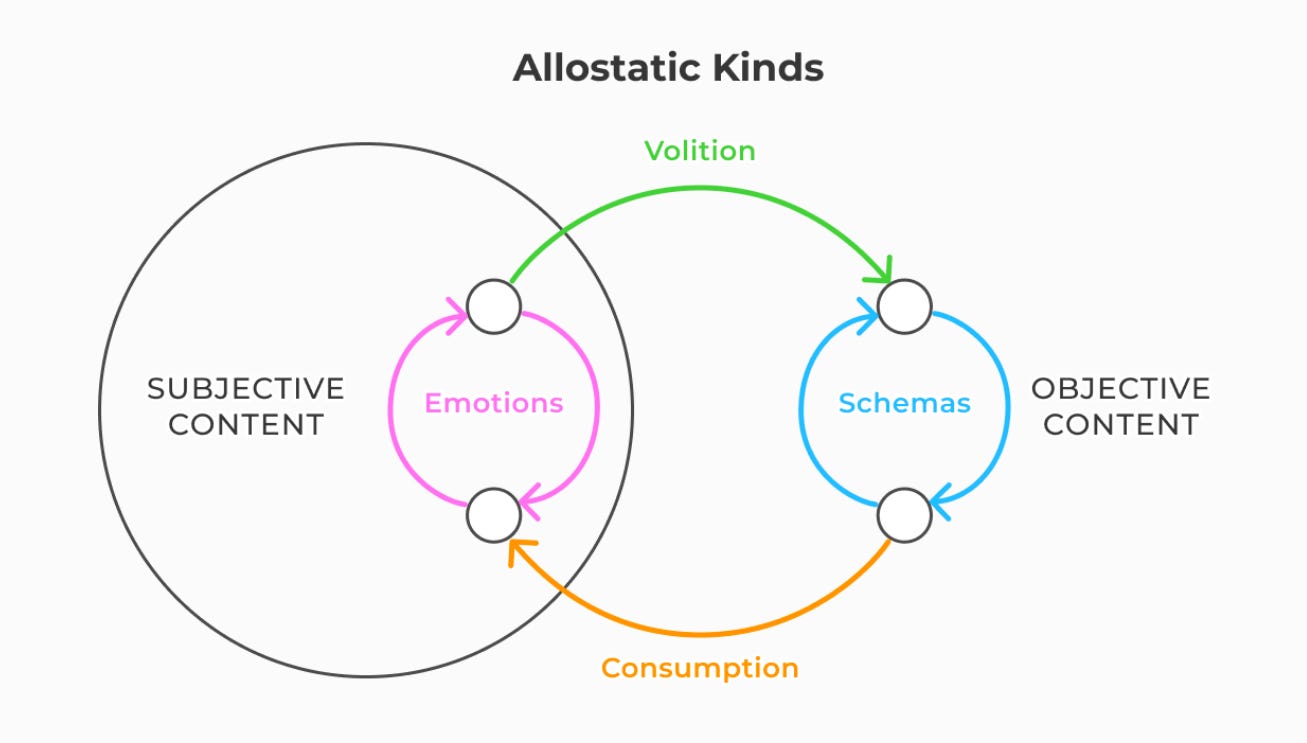
This is the direction our own research has taken. We have been developing several frameworks intended to describe, precisely and testably, how a broad, whole-state understanding of a system connects to its specific mechanical details. They are still in progress and need more groundwork than a single essay can provide, so we will introduce them properly later in the series. For now they give us reason to think this kind of meta-theory is possible as well as desirable.
Where this series goes
Over the next few installments we will define the kind of inquiry we have in mind, which we call mediated gestalt inference. We will begin with what it is, using phenomenological approaches and emotion among other examples, and then turn to what it tracks, namely connections that cannot be directly observed, and to how it generalizes.
From there we will trace how this inquiry was sidelined and examine existing frameworks that have challenged the divide, building on them rather than replacing them. Hegel’s idea of sublation offers one model. The yin–yang motif of complementary opposites, each containing a seed of the other, offers another model of integration. A loose tradition of Daoist-inspired thinkers, most prominently Fritjof Capra, has used it to argue that analytic and holistic knowledge are halves of one whole rather than rivals.10 Yuk Hui takes Daoism in a related direction: his idea of cosmotechnics holds that technology is not universal, and that different cosmologies lead to very different technologies and values.11
Donna Haraway’s cyborg serves as a figure for rejecting the division between reason and feeling, and the meeting of cybernetics with Deleuze and Guattari’s schizoanalysis supplies a further example. Most of these challenge the divide in theory, and the series asks how that challenge can become a working method alongside precise, immediate inquiry.
Further installments in this series turn to method. They examines the rhythm and features of integration that this essay has argued for, together with the conceptual tools, standards of evidence and infrastructure that integration would require, and it closes by connecting these ideas to several hard problems in medicine, consciousness research and AI.
Sources
Our prior work
Alicea, B., Cialfi, D., Lim, A. and Parent, J. (2021). Allostasis Machines: a model for understanding internal states and technological environments. PsyArXiv. https://doi.org/10.31234/osf.io/h5ykd
Parent, J., Lim, A., Zhang, J. L., Stares, N. and Alicea, B. (2021). Allostatic Kinds: Towards a Taxonomy of Permutations of Subject-Object Directionality in Causation. Neuromatch Conference 4.
Hard problems and the research hierarchy
Battleday, R. M. and Gershman, S. J. (2024). Artificial intelligence for science: The easy and hard problems. arXiv:2408.14508.
Bromham, L., Dinnage, R. and Hua, X. (2016). Interdisciplinary research has consistently lower funding success. Nature 534, 684–687.
Huh, M., Cheung, B., Wang, T. and Isola, P. (2024). The Platonic Representation Hypothesis. ICML 2024, 20617–20642.
Leahey, E., Beckman, C. M. and Stanko, T. L. (2017). Prominent but less productive: The impact of interdisciplinarity on scientists’ research. Administrative Science Quarterly 62(1), 105–139.
Sun, Y., Livan, G., Ma, A. and Latora, V. (2021). Interdisciplinary researchers attain better long-term funding performance. Communications Physics 4, 263.
Sutton, R. (2019). The Bitter Lesson.
Critiques of the hierarchy
Haraway, D. (1985). A Cyborg Manifesto. Socialist Review 80.
Keller, E. F. (1985). Reflections on Gender and Science. Yale University Press.
Snow, C. P. (1959). The Two Cultures and the Scientific Revolution. Cambridge University Press.
History
Bacon, F. (1605). The Advancement of Learning.
Damasio, A. (1994). Descartes’ Error: Emotion, Reason, and the Human Brain. Putnam.
Descartes, R. (1637). Discourse on Method; (1649). The Passions of the Soul.
Galilei, G. (1623). The Assayer (Il Saggiatore).
Barbara McClintock – Facts. NobelPrize.org.
Scott, J. C. (1998). Seeing Like a State. Yale University Press.
Weber, M. (1919). Science as a Vocation.
Philosophy of science and integration
Deleuze, G. and Guattari, F. (1980). A Thousand Plateaus.
Fleck, L. (1935). Genesis and Development of a Scientific Fact.
Hanson, N. R. (1958). Patterns of Discovery. Cambridge University Press.
Hegel, G. W. F. (1817). Encyclopaedia of the Philosophical Sciences, Part I (Logic), §§79–82.
Hui, Y. (2016). The Question Concerning Technology in China: An Essay in Cosmotechnics. Urbanomic.
Hui, Y. (2019). Recursivity and Contingency. Rowman & Littlefield.
Klein, G. (1998). Sources of Power: How People Make Decisions. MIT Press.
Kuhn, T. (1962). The Structure of Scientific Revolutions. University of Chicago Press.
Parent, J. (2024). On “Behavior, Purpose and Teleology”: Enduring Insights from a Cybernetics Classic. What’s Possible From Here (Substack), 17 October 2024. https://blog.jesparent.com/p/on-behavior-purpose-and-teleology
Polanyi, M. (1966). The Tacit Dimension.
Reichenbach, H. (1938). Experience and Prediction. University of Chicago Press.
Rosenblueth, A., Wiener, N. and Bigelow, J. (1943). Behavior, purpose and teleology. Philosophy of Science 10(1), 18–24
Insight, expertise, intuition and interpretation
Barais, M., Fossard, E., Dany, A., Montier, T., Stolper, E. and Van Royen, P. Accuracy of the general practitioner’s sense of alarm when confronted with dyspnoea and/or chest pain. (2020). BMJ Open 10(2), e034348.
Benner, P. (1984). From Novice to Expert. Addison-Wesley.
Dreyfus, H. L. and Dreyfus, S. E. (1986). Mind over Machine. Free Press.
Duncker, K. (1945). On Problem-Solving. Psychological Monographs 58(5).
Gadamer, H.-G. (1960). Truth and Method.
Ginzburg, C. (1979). Clues: Roots of a scientific paradigm. Theory and Society 7(3); revised in Clues, Myths, and the Historical Method (1989).
Kahneman, D. and Klein, G. (2009). Conditions for intuitive expertise: A failure to disagree. American Psychologist 64(6), 515–526.
Köhler, W. (1925). The Mentality of Apes.
Kounios, J. and Beeman, M. (2014). The cognitive neuroscience of insight. Annual Review of Psychology 65, 71–93.
Nersessian, N. J. (2008). Creating Scientific Concepts. MIT Press.
Oliva-Fanlo, B. et al. (2022). Prospective observational study on the prevalence and diagnostic value of general practitioners’ gut feelings for cancer and serious diseases. Journal of General Internal Medicine.
Peirce, C. S. Collected Papers, on abduction.
Wallas, G. (1926). The Art of Thought. Jonathan Cape.
Wertheimer, M. (1945). Productive Thinking. Harper.
Forthcoming, will be linked here when available.
Namely, the communities of Society Ethics Technology, Cognition Futures, and the JOPRO Futures Center, with an acknowledgement as well to the Orthogonal Research and Education Lab.
See Scholasticism, and Stanford Encyclopedia of Philosophy on medieval categories.
A related suite of interests centers on modern reclaiming of the concept of teleology, as seen in the seminal “Behavior, Purpose and Teleology”, where Rosenblueth, Wiener, and Bigelow attempt to salvage that term in the process of “striving towards a rigorous framework that could account for goal-directed behavior in both biological organisms and machines”, from Jes Parent’s commentary on their 1943 paper.
Together these moves set the pattern later called reductionism: explain a whole by breaking it into parts and the mechanical rules that connect them. Descartes made it a rule of method to divide each difficulty into as many parts as possible, and Francis Bacon dismissed the study of purposes, Aristotle’s final causes, as fruitless for natural philosophy. Bacon’s empiricism, which tied knowledge to observation and experiment, became the other pillar of the new science. Neither commitment on its own excluded felt or whole-system knowing; empiricism even begins from experience. The exclusion came from the combination, which counted only the experience that could be measured and explained wholes only through their parts. In the eighteenth century the Enlightenment carried that combination out of natural philosophy and into medicine, governance and public reason.
In short, we don’t think “science is bad” nor that empiricism or reductionism have no merits or substance. Rather, it’s about considering what, if anything, was “thrown out with the bathwater”, as the scientific method developed and proliferated as it did over the last several centuries. See also: Footnotes 3, 5.
Kuhn used “normal science” for the everyday work of a mature field: solving puzzles within an accepted paradigm that already defines which problems are legitimate, which methods count, and what a solution looks like. He called much of it “mopping-up operations,” but he did not mean this as dismissal. Normal science is what most scientists do most of the time, and its precision is what makes anomalies visible in the first place. In our terms, normal science is where precise, immediate inquiry does its best work, and it maps closely onto what Battleday and Gershman call the “easy problem.” They add a point we agree with: even normal science is not pure optimization, because deciding what to work on still requires formulating the problem. Holistic inquiry is not confined to rare revolutions. It is needed all the way down. (Kuhn, The Structure of Scientific Revolutions, 1962, chapters III–IV; Battleday and Gershman, “The hard problem” section.)
On top of all this, claims made in this field may be contentious due to its non-hegemonic re/centering and disruptive qualities.
Consider also David Krakauer’s commentary of how the concept of the steam engine and its governor would impact Wallace & Darwin’s take on natural selection.
These thinkers share several commitments: opposites define rather than exclude each other, relation and process come before fixed substance, and balance is dynamic rather than static. Niels Bohr took the yin–yang symbol as an emblem of complementarity, the principle that seemingly exclusive descriptions are both needed for a complete account. Capra (The Tao of Physics, 1975; The Turning Point, 1982) argued that modern Western culture had developed rational, analytic knowledge at the expense of intuitive, synthesizing knowledge. Peter Ping Li (2012) proposes “yin–yang balancing” as an epistemology that treats the two as a duality rather than a dualism. J. A. Scott Kelso and David Engstrøm (The Complementary Nature, 2006) build complementary pairs into a science of coordination in complex systems.