


A Cybernetic Foundation for the Contemporary World-Models Debate
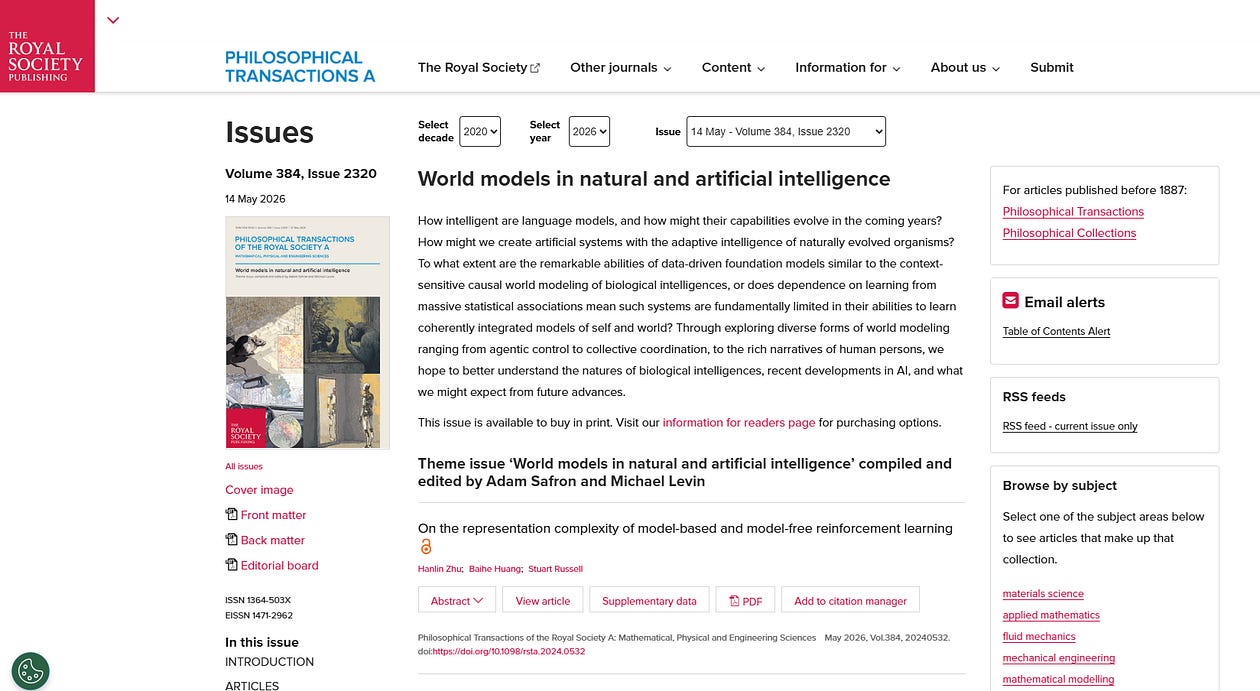
JOPRO is pleased to note the publication of a new article by Bradly Alicea, Morgan Hough, Amanda Nelson, and Jesse Parent, A ‘good’ regulator may provide a world model for intelligent systems, appearing in the May 2026 issue of Philosophical Transactions of the Royal Society A: Mathematical, Physical and Engineering Sciences (Vol. 384, Issue 2320, article 20250007; DOI: 10.1098/rsta.2025.0007).
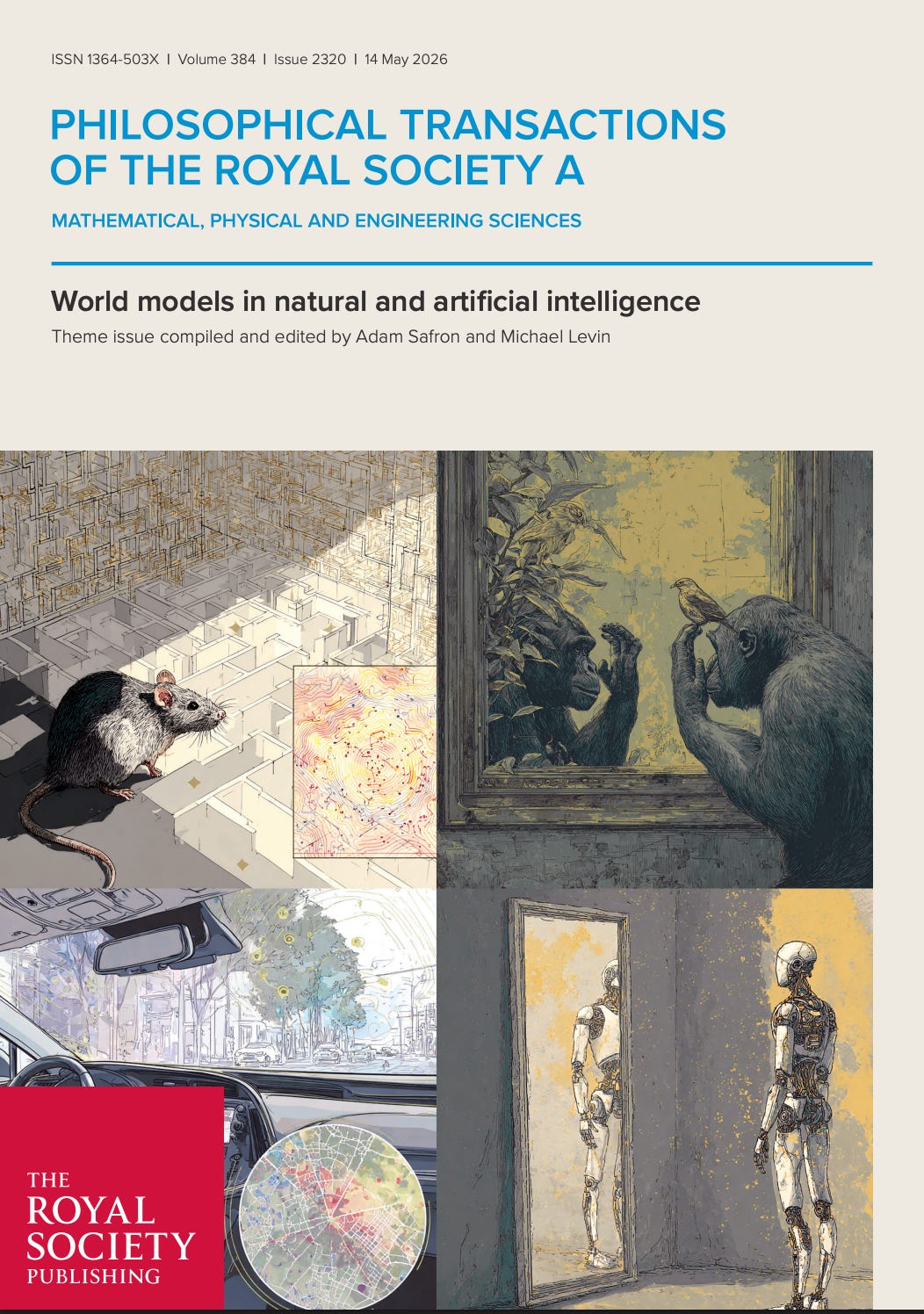
The paper is one of eighteen contributions to the themed issue World models in natural and artificial intelligence, organized by Adam Safron Adam Safron and Michael Levin Michael Levin. The collection assembles contemporary work on the question of how biological and artificial systems construct, maintain, and revise internal representations of the worlds in which they act, spanning causal, self-referential, goal-directed, collective, and narrative forms of world modelling.
The Argument in Brief
The article revisits the Every Good Regulator Theorem (EGRT), introduced by Roger Conant and W. Ross Ashby in 1970, which holds that any sufficiently effective regulator of a system must in some meaningful sense embody a model of that system. The authors argue that this classical cybernetic result, often treated as a historical curiosity in the lineage of mid-twentieth-century control theory, supplies a productive analytic frame for current debates about world models in machine learning, reinforcement learning, and the architecture of intelligent autonomous systems.
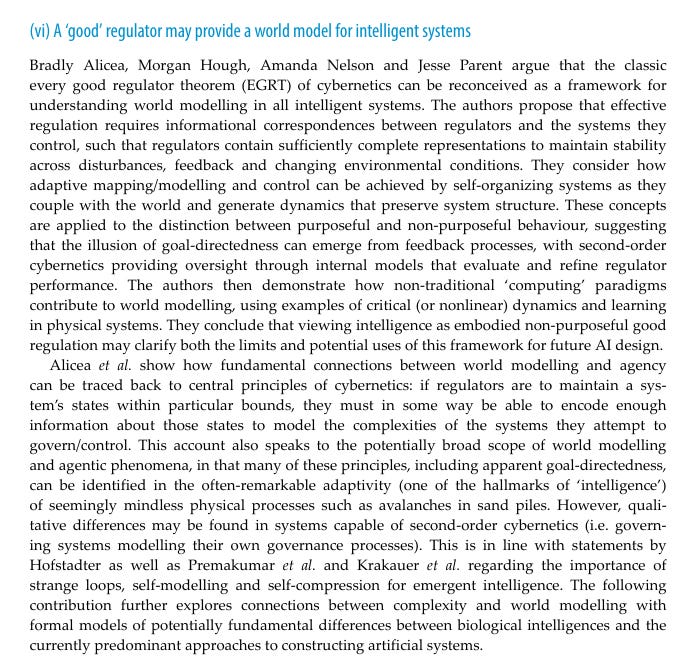
The paper develops three principal moves. It re-examines the original mapping between regulator and system as a form of compressed global representation that preserves the variety required to track the full range of system outcomes. It extends the EGRT to a second-order cybernetic setting in which an internal model observes and supervises the closed-loop coupling between regulator and system. And it considers how physical phenomena, including temporal criticality, non-normal denoising, and alternating procedural acquisition, can be recast as statistical-mechanical regularities that yield regulatory relationships in non-traditional substrates. The result is a reading of intelligence as a form of embodied, and not necessarily purposeful, good regulation.
The Themed Issue and Its Editorial Framing
Readers approaching the contribution for the first time may benefit from beginning with the issue’s introductory article, World models, artificial general intelligence and the hard problems of life-mind continuity: toward a unified understanding of natural and artificial intelligence, by Adam Safron, Michael Levin, Victoria Klimaj, Zahra Sheikhbahaee, Dalton Sakthivadivel, Adeel Razi, David Ha, Nick Hay, Kevin Schmidt, Irina Rish, David Krakauer, Melanie Mitchell, Samuel J. Gershman, and Joshua B. Tenenbaum. The piece offers a synoptic framing of the questions the collection sets out to address and locates each contribution within the broader landscape of world-modelling research across cognitive science, machine learning, complex systems, and the biology of mind.
The Alicea et al. contribution sits within that landscape as a specifically cybernetic intervention: a reminder that several of the conceptual structures now being rediscovered in foundation-model research were articulated, with considerable rigor, decades before the present wave of interest in world models took shape.
Relation to JOPRO & Orthogonal Research & Education Labs Research Thrusts
The article extends a sustained line of inquiry within JOPRO’s Cognition Futures working group, which examines the historical, conceptual, and methodological relationships between mid-twentieth-century precursors and the contemporary research landscape in artificial intelligence and cognitive science.
The paper draws on themes developed through the Representational Brains & Phenotypes working group housed at Orthogonal Research and Education Lab (OREL) and led by Bradly Alicea Dr. Bradly Alicea , particularly in its treatment of internal modelling and the conditions under which a system can be said to maintain a useful model of its environment.
OREL’s Reimagining Cybernetics project (Cybernetic Interests Group) treats cybernetic thought not as historical background but as a still-active reservoir of analytic resources for present questions about agency, representation, and the architecture of intelligent systems.
About the Article
Title: A ‘good’ regulator may provide a world model for intelligent systems
Abstract: One classic idea from the cybernetics literature is the Every Good Regulator Theorem (EGRT). The EGRT provides a means to identify good regulation, or the conditions under which an agent (regulator) can match the dynamical behaviour of a system. We re-evaluate and recast the EGRT in a modern context to provide insight into how intelligent autonomous learning systems might utilize a compressed global representation (world model). One-to-one mappings between a regulator (R) and the corresponding system (S) provide a reduced representation that preserves useful variety to match all possible outcomes of a system. The EGRT also extends to second-order cybernetics, where an internal model (M) observes the behaviour of S and supervises an S–R closed-loop mapping. Secondarily, we demonstrate how physical phenomena such as temporal criticality, non-normal denoising and alternating procedural acquisition can recast behaviour as statistical mechanics and yield regulatory relationships. These diverse physical systems challenge the notion of tightly coupled good regulation when applied to non-uniform and out-of-distribution phenomena. Overall, we aim to recast the EGRT as a potential approach for developing world models that adapt and respond to a wide range of task environments.
This article is part of the theme issue ‘World models in natural and artificial intelligence’.
Additional Information
Article: A ‘good’ regulator may provide a world model for intelligent systems (DOI: 10.1098/rsta.2025.0007)
Themed issue: World models in natural and artificial intelligence, edited by Adam Safron and Michael Levin
Introductory article: World models, artificial general intelligence and the hard problems of life-mind continuity
OREL Medium post bt Bradly Alicea.
JOPRO publication database (in development): Good Regulator, World Model, Intelligent Systems (2025)
Jesse Parent commentary on 1943 paper “Behavior, Purpose, and Teleology” by Rosenblueth, Wiener, and Bigelow
A version of this article appears on jopro.org