


This year, many of the people we worked with — researchers, practitioners, and builders across fields — shared a similar concern. They were learning quickly, adopting new tools, and meeting the expectations placed in front of them. Yet many felt uncertain about how their work fit together, how to make decisions with long-term consequences, or how to grow into roles that require more than execution alone.
What stood out was not confusion, but a lack of orientation: a sense that the systems engulfing us offer brittle outputs and legacy credentials, with a pronounced lack of guidance for becoming responsible, wayfinding actors within complex, evolving fields. The formation of discernment, building coherence beyond disciplinary silos, and the ability to navigate uncertainty are increasingly treated as discrete, private, or even irrelevant problems.
One hears a growing resignation: this is out of our hands; better to look away or focus elsewhere, or elsewhen. That posture sits uneasily beside the agentic rhetoric of flourishing-centered technologists, ethically-courageous innovators, or indeed philosopher-builders. The more generative stance has often been quieter and more demanding: nobody taught us how to do what this moment requires — so we are teaching ourselves.
Speaking of philosopher-builders, as Brendan McCord noted during the Cosmos Institute’s year-end note: “Technology that expands what is possible may narrow who is possible. But it need not.”
I would extend that observation beyond who to where. When the range of who is possible contracts, so too does the range of futures we can chart — along with the institutional and epistemic pathways that make those futures reachable.
The moment we find ourselves in
For much of the last century, our institutions for learning, research, and innovation were designed around narrower assumptions, clearer disciplinary boundaries, slower feedback cycles, and more homogeneous pathways into expertise and authority.
Even then, many forms of knowledge, experience, and responsibility were marginalized or excluded. Today, as complexity accelerates and domains collide, those limitations are no longer merely unjust or inefficient — they are structurally misaligned with the kinds of problems people are now being asked to work on.
The challenge is not that we’ve lost a golden age of formation, but that we are encountering, at scale, the consequences of institutions that were never built to support integrated comprehensions, cross-field coordination, or long-horizon responsibility in the first place.
JOPRO exists because those gaps keep showing up in practice — across fields, institutions, and career stages. It shows up when early-career researchers are technically prepared but strategically ungrounded. It shows up when interdisciplinary work collapses under the weight of mismatched assumptions and timelines. And it shows up when conversations about ethics or responsibility are detached from the lived realities of learning, leadership, and decision-making.
Over time, it became clear that addressing this gap could not be done by focusing on any single program, discipline, or institution in isolation. The challenges we’re pointing at — fragmentation, loss of orientation, shallow integration — are not failures of individual effort, but of the surrounding ecosystems people are asked to operate within.
That realization shaped how our vision has evolved during the year. Instead of treating JOPRO as a standalone platform or pipeline, we increasingly understood our work as part of a broader landscape: one that depends on relationships between groups, shared language across domains, and people willing to take on the work of translation and coordination.
In other words, the question became not just what we build, but how the conditions for building — and becoming — are cultivated.
In practice, this has meant focusing on work that tends to be neglected in periods of rapid technological acceleration. Such upstream work is slower and difficult to measure. But we’ve come to believe it is essential if new technologies and ideas are going to land inside systems that can actually absorb them responsibly. Or, harder yet, mapping trajectories of where systems are going, and discerning which developments drive or dissipate movement along those pathways.
Cultivating Ecosystems and Operators
One way we’ve come to describe this moment is simply: it is not enough to have discrete ideas. (Or technologies). What matters now is whether those insights can be translated into durable practices, institutions, and cultures that actually shape how systems behave.
At JOPRO, we’ve increasingly come to see our role not only as incubating and mentoring, but evolving to help cultivate ecosystems of makers, operators, and visionaries — people and groups capable of carrying ideas across domains, coordinating across institutions, and doing the often invisible work of translation. That means showing up in spaces where thoughtful work is already happening, learning from those efforts, and contributing where we can.
This year, that took many forms.
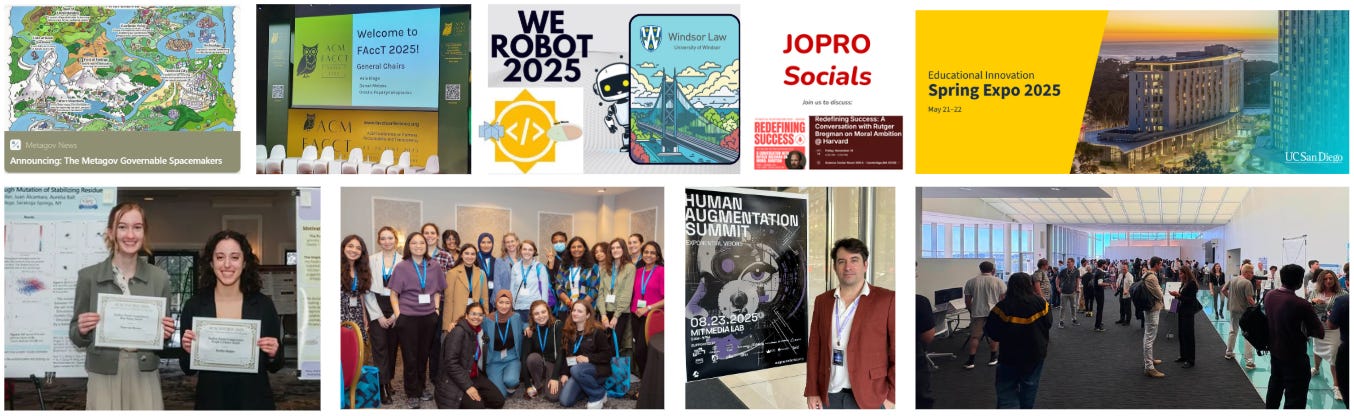
We continued deep collaboration with Orthogonal Research and Education Lab, JOPRO’s longtime partner, particularly through the Society Ethics Technology working group. Together, we explored questions of project management, leadership, and coordination in research and innovation spaces — topics that are rarely treated as first-order concerns, but which often determine whether good ideas survive contact with reality.
We also stayed closely connected to Plot Twisters, a JOPRO sister group building on work supported by OpenIDEO’s Designing for Digital Thriving grant and Metagov’s Governable Spacemaker Fellowship. Plot Twisters exemplifies the kind of experimental, practice-oriented inquiry we believe is essential for understanding agency & narrative, digital spaces, and individual & community sensemaking as tractable design challenges rather than abstract problems.
Across the year, members of the JOPRO community participated in and learned from a number of adjacent ecosystems. We attended events and followed the growth of Advancing Humans with AI (MIT), a community whose emphasis on human-centered AI aligns closely with our own concerns, and whose continued evolution we’re excited to see in the year ahead.
We’ve also been in conversation with, and inspired by, organizations like Distributed AI Research Institute, particularly around their Possible Futures workshop series, which foregrounds participatory approaches to imagining technological trajectories. Similarly, many in our community engaged with Cosmos Institute, including participation in the Oxford AI x Philosophy Seminar — a reminder of how valuable serious philosophical engagement remains in technical domains.
In more applied and embodied spaces, JOPRO members attended events hosted by groups like Augmentation Lab, and we exhibited at the AugLab Summit at the MIT Media Lab. In addition to supporting the Summit, our colleagues at ekkolápto convened numerous salons and events across crucial frontiers — creating space for reflective engagement with questions of technology, “Cognition Futures,” and human experience. Together, these environments challenged us to think more carefully about how narratives, interfaces, and systems shape human capability.
We also engaged with communities focused on values, responsibility, and career pathways, including School for Moral Ambition, whose work on alternative and impactful career trajectories resonates strongly with many in the our network. We reconnected with collaborators at Princeton Envision, as they revived the Envision conference series with renewed emphasis on data ethics and responsible AI.
Taken together, these relationships reflect a simple conviction: no single organization will solve the problems we’re facing. Progress depends on overlapping communities, shared language, and people willing to operate across boundaries — intellectually, institutionally, and ethically. JOPRO’s work this year has been shaped by that belief, and the projects we built grew directly out of these ongoing conversations and collaborations.
What we advanced this year
This year at JOPRO was less about scaling a single program and more about laying interlocking foundations. Across research, pedagogy, and community work, we were asking a consistent question: what does it look like to design learning, inquiry, and leadership structures that are actually responsive to the conditions people are navigating now?
Rather than answering that in the abstract, we tested it in practice — across education, research, and public engagement — letting each strand inform the others over the course of the year.
Throughout the year, much of our work focused on education and learning ecosystems. We formalized what we’ve been developing implicitly for years into a framework we call JOPRO & the New Learning Ecosystem. This work articulates an approach to learning that is contextual, developmental, and trajectory-aware — designed for interdisciplinary spaces where people are often navigating multiple identities, skill sets, and time horizons at once.
We shared this framework the spring at the UC San Diego Education Innovation Expo, using it to demonstrate how pedagogy, technology, and mentorship can be designed together rather than treated as separate layers. That same philosophy guided our participation in Google Summer of Code through Orthogonal Research and Education Lab (and sponsor International Neuroinformatics Coordination Facility), where JOPRO supported scholars contributing to open-source and research projects at the intersection of computation, biology, and ethics. These efforts reinforced a core belief: meaningful learning happens when people are embedded in real problems, with real responsibility, and adequate scaffolding.
As the year progressed, this educational work increasingly intersected with public engagement and institutional presence. In the summer, JOPRO exhibited at the Human Augmentation Summit hosted at MIT Media Lab, contributing to conversations about human potential, augmentation, and the social consequences of emerging technologies. Members of our community also engaged with global research communities through conferences like ACM Conference on Fairness, Accountability, and Transparency in Athens under the Data x Direction banner, exploring questions of fairness, accountability, and participatory approaches to AI.
Through our Society Ethics Technology working group, JOPRO was represented at WeRobot 2026 — a leading conference at the intersection of law, robotics, and policy — and we organized a panel at ACM’s New York Celebration of Women in Computing (NYCWiC), centering early-career researchers navigating innovation spaces across academia and industry. In these settings, JOPRO wasn’t just presenting progress; we were stress-testing ideas, building relationships, and clarifying where our voice adds value.
Running alongside this public work was a deeper strand of research and sensemaking. Over the course of the year, we developed Something In The Way: An Ethnography of 21st Century Directionlessness, a project in the Mental Health Paradigms & Perspectives working group aimed at documenting what it feels like to be adrift in contemporary life — professionally, cognitively, and morally. Drawing from ethnography and phenomenology rather than optimization frameworks, this work shaped how we think about mentorship, leadership, and learning: not as linear pipelines, but as processes that must account for uncertainty, fragmentation, and uneven development.

Late in the year, many of these threads came together. In December, we launched DigiNEST (Digital Narratives and Emerging Story Technologies), a new reading group and discussion space exploring narrativity, agency, and emerging technologies. DigiNEST sits at the intersection of digital humanities, philosophy, psychology, and design, and reflects JOPRO’s conviction that questions of ethics and governance are inseparable from questions of story, identity, and meaning-making. In many ways, DigiNEST represents a synthesis of the year’s work: a space where research, pedagogy, and community converge.
Running through all of this was a quieter but essential effort: field-building and mentorship. Projects such as From Here to There and Data x Direction (both of which are spinoffs from my capstone coursework at UC San Diego) are not products in the conventional sense; they are attempts to offer language, structure, and guidance for people navigating complex innovation landscapes without clear maps. Data x Direction, in particular, had a wonderful initial internship cohort and serves as a growing community within the broader JOPRO umbrella.
These efforts reflect a belief that leadership today is less about authority and more about helping people orient themselves — intellectually, ethically, and strategically — over time.
Taken together, this year’s work assuredly didn’t resolve the tensions we’re studying. It created shared reference points. New vocabularies. Prototypes for learning, inquiry, and collaboration that can continue to evolve. As an organization, we continued to practice incubation for projects, and grew in our capacity to cultivate context and capacity.
Vision for 2026
As we look ahead, much of our focus will be on deepening the work that began this year — and bringing it into clearer, more sustained forms.
In the coming year, JOPRO will continue to show up in public-facing spaces where questions of technology, ethics, and leadership are actively being shaped. This includes delivering a keynote at Princeton Envision in February, as well as hosting a Future of Work and Tech Careers panel at NYCWiC 2026. These moments matter to us not simply as visibility, but as opportunities to engage early-career researchers and practitioners who are navigating real decisions about where and how to apply their skills.
We’re also continuing to develop new formats for sustained inquiry and discussion. DigiNEST will grow in the year ahead as a space for grappling with narrativity, agency, and emerging technologies, and we expect to be involved in a range of additional Discussion Series, collaborations and events as these conversations evolve. Alongside this, we’re continuing to expand local gatherings in Boston and New York, as well as hybrid and virtual events with inquisitive communities such as communities ekkolapto, Frontier Tower, and the Oxford Internet Institute.
A major focus for the year ahead will be the launch of the JOPRO Futures Center. The Center is an extension of work we’ve been circling for some time: creating a dedicated space for developing meaningful alternatives to prevailing systems and assumptions. This will include exploratory projects, long-horizon research, and a forthcoming invitation-only cohort for serious philosophical and strategic discussion — focused on crafting the skills, curricula, and organizations needed to bridge the world as it is with the world as we might prefer it to be.
As always, we don’t see this as something JOPRO does alone. The most important work ahead will happen through collaboration: with people willing to think carefully, act responsibly, and take the long view even when incentives push in the opposite direction. If that resonates with you, whether as a collaborator, participant, doner, or quiet supporter, we’d love to stay in conversation.
What ultimately matters is not only what technologies are being built, but what we are able to perceive, comprehend, and coordinate as we navigate the paths they open. The quality of that understanding and the structures that support it will shape far more than any single project.
To everyone who contributed time, thought, care, and trust this year: thank you. This work is only possible because it is shared.
Jes
JOPRO coordinates and cultivates researchers, builders, and practitioners working to modernize how knowledge is generated and applied across domains.
Our work combines project incubation and operator formation with working groups, workshops, and seminar series— supporting both field-level transitions and focused research efforts, in collaboration with academic, civic, and industry partners.
Wow, congrats on the Princeton Envision speaking gig!! I may apply to speak there myself...